
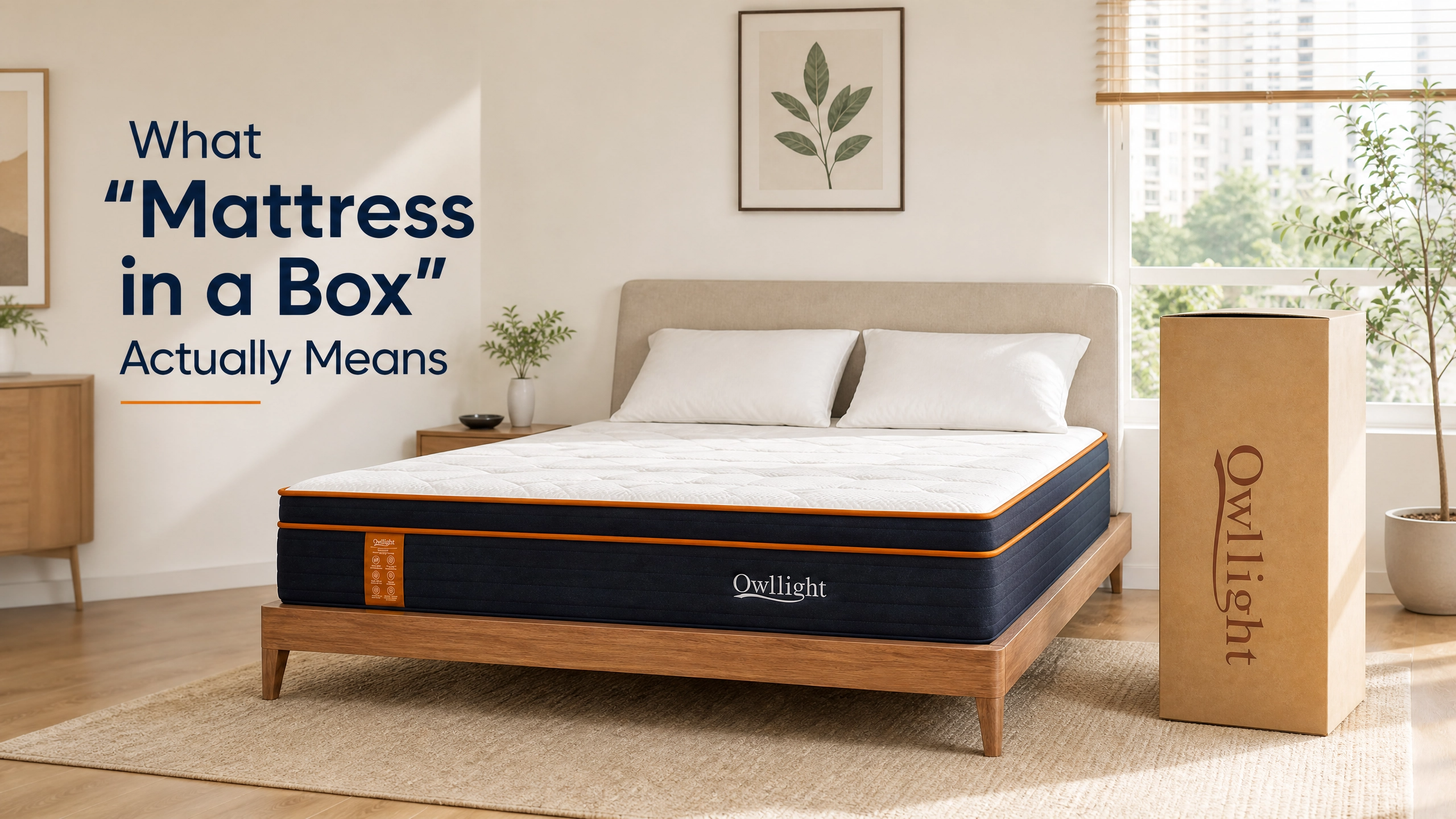
A mattress in a box is a full-size mattress compressed, vacuum-sealed, and rolled into a carton small enough for one person to carry through an HDB lift and front door. You unbox it, unroll it, and it expands to full size over a few hours. It suits anyone living in a walk-up or a flat with a tight lift, and anyone who hates scheduling a bulky furniture delivery. The trade-off: you can't lie on it in a showroom first, so the trial period matters more than the box. Owllight's Tulip ships boxed and carries a 100-night trial. You can also test out the mattress at our showroom, before ordering it.
Most Singaporeans buying a mattress picture the same scene: two delivery men, a flatbed truck, and a king-size slab that somehow has to make it past a narrow corridor and a 90-degree turn into the master bedroom. The mattress in a box exists to delete that scene entirely.
It's now the default way most online mattress brands ship in Singapore. But "boxed" describes the packaging, not the mattress inside — and the part that matters for your back is still the construction, not the carton. Here's how the format actually works, what it's good at, where it falls short, and who it genuinely suits.
What "Mattress in a Box" Actually Means
A mattress in a box — also called bed-in-a-box — is a standard mattress that has been compressed under industrial pressure, vacuum-sealed in plastic, then rolled tight and slid into a cardboard carton. A queen mattress that's 25cm thick on your bed frame ships as a roll roughly the size of a golf bag.
The compression is temporary and by design. Once you cut the seal, air re-enters the foam and spring layers and the mattress returns to its full dimensions. Nothing about the material is altered — the same foam, the same springs, the same cover that would arrive on a traditional flatbed delivery, just packed for transport.
This is not a different category of mattress. A hybrid, a memory foam, or a pocket-spring mattress can all ship boxed. The box is a delivery method, not a product type.
How the Compression Works
Two things make a mattress compressible: open-cell foam layers that release trapped air under pressure, and pocket springs that can be flattened individually without permanent damage. The factory uses a roll-packing machine that vacuums the air out, presses the mattress flat, and rolls it under tension before the plastic is sealed.
The mattress holds that compressed state until you break the vacuum. Reputable brands limit how long a mattress should sit boxed, typically a few weeks to a couple of months because foam that stays compressed too long can take longer to recover full loft. If you're buying boxed, unbox within the window the brand specifies rather than storing it rolled for half a year.
The Unboxing and Expansion Process
Unboxing is genuinely simple, and that's most of the appeal. The realistic sequence:
- Carry the box to the room first. A boxed queen is far easier to move while compressed than after it expands. Get it onto the bed frame before you open anything.
- Position the roll on the frame in the orientation you want it, then cut the outer plastic.
- Unroll and remove the inner vacuum seal. The mattress will start expanding the moment air re-enters — you'll hear it.
- Let it breathe. Most mattresses reach usable shape within 1–4 hours and full height within 24–72 hours.
- Air the room. A faint "new foam" smell (off-gassing) is normal for the first day or two. Open a window or run the fan. It dissipates faster on certified low-VOC foam.
You can usually sleep on it the first night, though the mattress may still feel marginally firmer until it fully decompresses. Give it a few nights before judging the feel — your body and the mattress both need to settle.
Why the Box Format Suits Singapore Homes Specifically
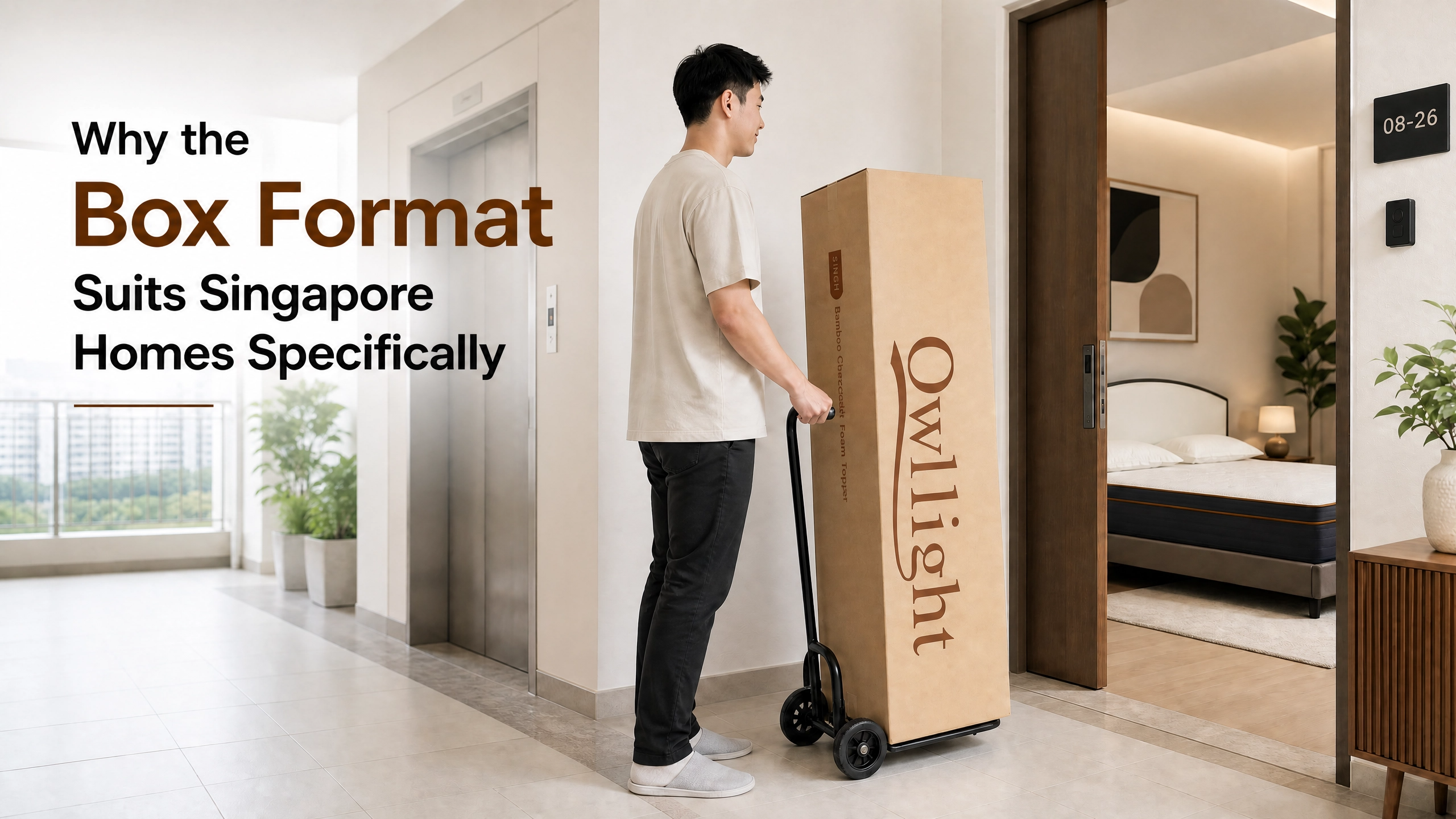
The bed-in-a-box format solves problems that are particularly Singaporean:
HDB lift and corridor access
A traditional king mattress is awkward to manoeuvre into a flat with a standard HDB lift, and impossible to flex around a tight internal corridor. A box clears the lift, the front door, and the bedroom doorway without drama. For walk-up apartments and older blocks without a service lift, the box is often the only practical option.
No delivery slot to wait at home for
Boxed mattresses ship by standard courier. You don't need to block out a four-hour delivery window or coordinate two-man handling. For shift workers and WFH households juggling schedules, that flexibility is real.
Easier to move
Singaporeans move flats often — between rentals, upgrades, and BTO handovers. A boxed mattress is simpler to set up the first time, though note that once expanded, a mattress generally cannot be re-compressed at home to box-size again.
The Pros
- Fits through any HDB entrance. The single biggest practical advantage in Singapore's housing stock.
- One-person setup. No need to be home for a two-man delivery team.
- Often cheaper. Direct-to-consumer boxed brands skip showroom and warehouse overheads, which usually shows up in the price.
- Hygienic in transit. The mattress is sealed at the factory and only opened in your home — it isn't handled or unwrapped in a warehouse first.
- Lower delivery friction. Standard courier rather than scheduled furniture logistics.
The Cons
- You can't always try it in a showroom. The trial period matters and opt for Owllight as you could try the mattress in our showroom first.
- Initial off-gassing. A short-lived foam smell on opening. Normal, but worth airing the room for a day.
- Expansion wait. The mattress isn't at full height instantly, plan for it to settle over the first day or two.
- No easy re-compression. Once expanded, you can't realistically re-roll it into the box for a future move.
- Box format doesn't guarantee back support. A poorly built boxed mattress is still a poorly built mattress. The construction inside is what protects your back, not the packaging.
Who a Mattress in a Box Suits
The format genuinely suits most Singapore households, but it's a clear yes for some:
- Walk-up and older-block residents where a bulky flatbed delivery is impractical.
- Anyone with a tight HDB lift or narrow corridor who has dealt with a furniture delivery getting stuck before.
- Renters and frequent movers who value easy first-time setup.
- Online-first buyers comfortable choosing on specs and reviews, provided there's a real trial period to fall back on.
It's a weaker fit if you specifically want to lie on the exact mattress before committing and there's no trial — though in that case, a generous in-home trial closes most of the gap, because a few minutes in a showroom tells you far less than a few weeks in your own bed.
Bed-in-a-Box vs Traditional Mattress Delivery
The difference isn't the mattress — it's the logistics and what they cost you.
- Access: A box clears any HDB entrance. A traditional flatbed delivery can be blocked by a tight lift or corridor.
- Scheduling: Boxed ships by courier on a flexible window; traditional needs a booked two-man slot.
- Try-before-you-buy: Traditional often comes from a showroom you visited; boxed relies on the trial period instead.
- Setup: Boxed is one-person and self-service; traditional is placed for you but you wait at home.
- Old mattress disposal: Some traditional deliveries include haul-away; with boxed, check whether the brand offers disposal or you arrange a Town Council bulky-item collection.
For most Singapore homes, the box wins on access and convenience. The one thing it asks of you is to trust the construction and the trial rather than a showroom visit — which is reasonable, as long as both are solid.

How to Choose a Boxed Mattress for Back Care
Because you're choosing on specs rather than a showroom, the specs have to do the work. For back care specifically, look for:
- Zoned support, not uniform firmness. A correctly sized hybrid with zoned pocket springs keeps the spine neutral — firmer under the lower back, softer under the shoulders. The Tulip uses a 5-zone Pro-S pocket spring system for exactly this.
- Cooling built into the structure. In Singapore's humidity, airflow matters. Open-cell layers and pocket springs move heat far better than solid foam. The Tulip layers 4D Air Fiber over its springs for structural airflow rather than a chemical cooling treatment.
- Certified foam. CertiPUR-US foam layers mean lower-VOC off-gassing — relevant since boxed mattresses are unsealed in your bedroom.
- A genuine trial and warranty. Non-negotiable when you can't try it first. A 100-night trial and a multi-year warranty are the safety net the box format relies on.
If your current mattress is still structurally sound but you mainly want to fix heat or add support, a boxed mattress isn't your only route — a cooling and back-care topper can address those without replacing the whole bed. And if you have a non-standard frame or bed size, a custom mattress can be made to fit. For when a replacement is genuinely due, our guide on when to replace your mattress walks through the signs.
See the Tulip Cooling Back Care Mattress →
Frequently Asked Questions
How long does a mattress in a box take to expand?
Most boxed mattresses reach a usable shape within 1–4 hours of opening and full height within 24–72 hours. You can usually sleep on it the first night, though it may feel slightly firmer until it fully decompresses. Give it a few nights before judging the feel, as both the mattress and your body need time to settle.
Is a mattress in a box as good as a regular mattress?
Yes — the box is only a delivery method. The same foam, springs, and cover ship boxed as would arrive on a traditional flatbed delivery; compression is temporary and doesn't alter the materials. What determines quality is the construction inside, not the packaging. A well-built boxed hybrid with zoned pocket springs supports your back exactly as it would if delivered uncompressed.
Does a mattress in a box fit through an HDB lift?
Yes. A compressed and rolled queen mattress is roughly the size of a golf bag, so it clears a standard HDB lift, front door, and bedroom doorway without difficulty. This is the format's biggest practical advantage in Singapore, especially for walk-up apartments and older blocks without a service lift, where a bulky flatbed mattress is hard or impossible to manoeuvre in.
Can you re-box a mattress in a box after opening it?
Not realistically at home. The original compression uses an industrial vacuum and roll-packing machine that can't be replicated with household tools. Once a mattress has expanded, plan to move it at full size rather than re-rolling it into the box. If you move flats often, factor this in — though setting up a boxed mattress the first time is still far easier than a traditional delivery.
Why does a mattress in a box smell when first opened?
A faint foam smell on opening is normal off-gassing — trapped air and harmless compounds releasing as the foam decompresses. It usually clears within a day or two, faster if you air the room or run a fan. Mattresses using CertiPUR-US certified foam are tested for low VOC emissions, so any odour is milder and dissipates more quickly.