.png?w=615&h=171)
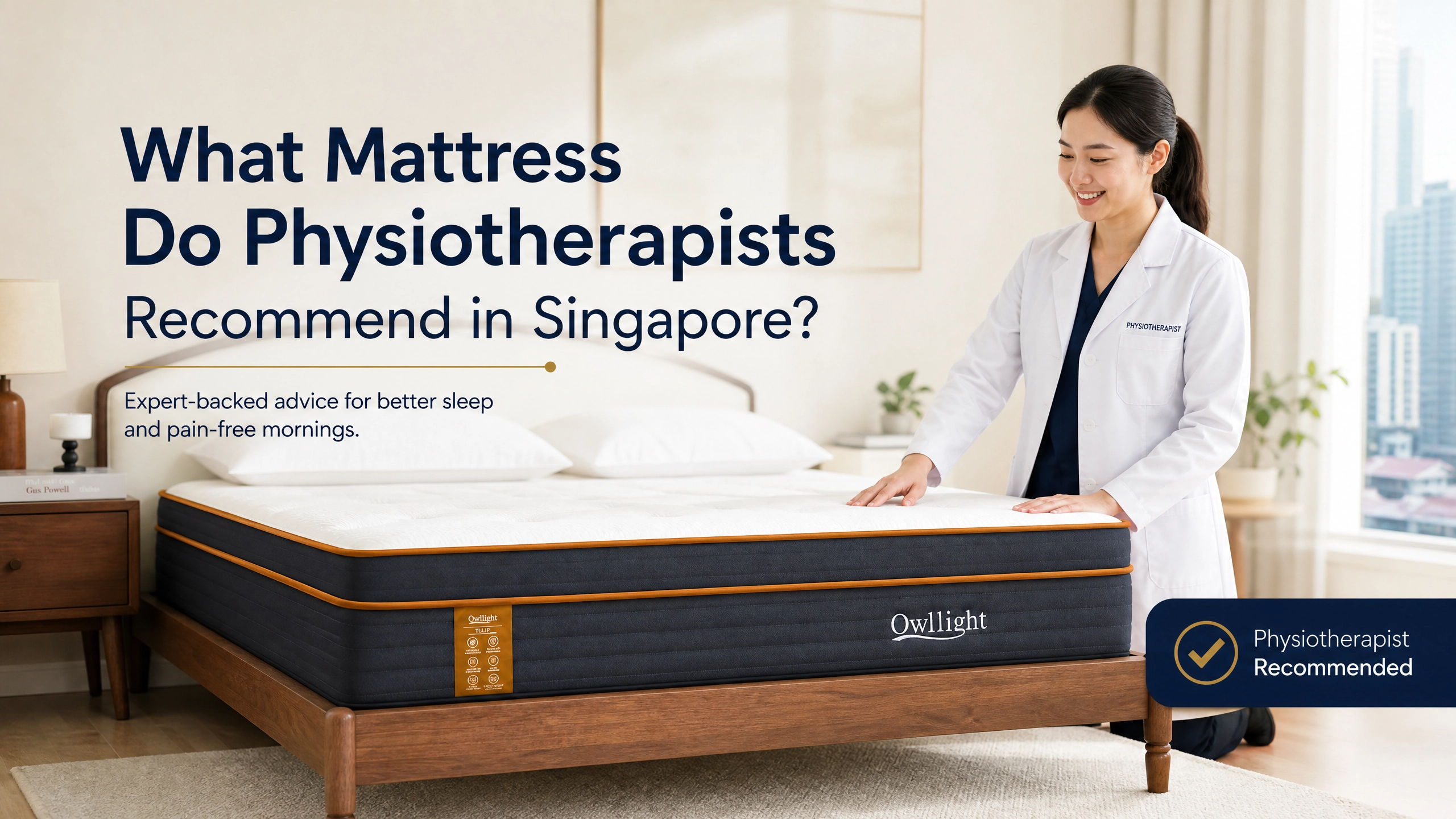
Physiotherapists consistently recommend a mattress that maintains spinal neutral alignment for your specific sleep position — not the firmest option, and not the softest. Key criteria: medium-firm feel, zoned pocket spring for independent pressure relief, CertiPUR-US certified foam (no harmful off-gassing), and materials that hold their shape over years, not months. A 100-night trial period is the minimum worth considering, because you can't assess spinal support in a 10-minute showroom lie-down. "Orthopedic mattress" is a marketing term, not a clinical category and what matters is the spec behind the label.
Why a Physiotherapist's Criteria Is Different From a Sales Pitch
Walk into any mattress showroom in Singapore and the salesperson will ask you to lie down, nod appreciatively, and describe a mattress as "supportive." What they usually mean is that it feels firm underfoot and doesn't sag visibly. That is not what a physiotherapist means by support.
A physiotherapist is assessing your musculoskeletal system, the relationship between your spine, your hip alignment, your shoulder girdle, and the surface you're sleeping on for seven or eight hours a night. They're asking a different set of questions. Does this mattress keep your spine in a neutral position? Does it distribute your body weight without creating pressure points that force you to shift position repeatedly? Will it hold its structural integrity in two years, or in five?
These are functional questions. Most mattress marketing doesn't answer them, it redirects you toward comfort language that tells you very little about what the mattress will actually do to your spine over time.
This post works through the clinical criteria physiotherapists actually use. Not brand claims. Not comfort scores. The structural and material factors that matter when your back is the reason you're shopping for a new mattress.
The 4 Things Physiotherapists Actually Look at in a Mattress
1. Spinal Neutral Alignment
Your spine has a natural S-curve. When you're standing correctly, your lumbar region curves inward, your thoracic region curves outward, and your cervical spine (neck) curves inward again. The goal of sleep is to maintain something close to this curve — not to flatten it, and not to exaggerate it.
A mattress that is too firm pushes your hips and shoulders upward, forcing your lumbar spine to hang unsupported in the gap between. A mattress that is too soft lets your heaviest point, usually the hips sink too deep, rotating your pelvis and collapsing the lumbar curve. Both scenarios mean your spine spends hours in a mechanically stressed position. You wake up stiff. Over time, that stiffness becomes a pattern.
The physiotherapist's question is not "does this feel comfortable?" It's: "does this mattress maintain the natural curve of your spine in your preferred sleep position?" Those are different questions with different answers depending on whether you sleep on your side, back, or stomach.
2. Pressure Distribution
When you lie on your side, two contact points bear most of your body weight: your hip and your shoulder. If the mattress is too firm at those points, it creates pressure while the blood flow is partially restricted, and your nervous system triggers micro-awakenings to make you shift position. You don't remember these. You just feel like you slept badly.
Good pressure distribution means the mattress yields slightly at the hip and shoulder, absorbing load without collapsing entirely. This is what pocket spring systems do well, each spring responds independently to the force applied to it, rather than the whole surface moving as one unit. The result is contouring at high-load points while maintaining support elsewhere.
A mattress that distributes pressure well reduces the number of times you unconsciously reposition during the night. That means more time in deep sleep. That is the clinical outcome physiotherapists care about.
3. Support Consistency Over Time
A mattress that performs well on night one and sags significantly by month eighteen is not a back-care mattress. It's a mattress with a short useful life for anyone with back pain.
Foam-only mattresses, particularly those made with lower-density foam, are more prone to body impressions over time. The foam compresses under repeated load and doesn't fully recover. Pocket spring systems, particularly those using individually wrapped springs with sufficient coil count, hold their shape considerably longer because the structural load is distributed across the spring unit rather than absorbed entirely by foam.
This is one reason physiotherapists tend to be cautious about recommending foam-only mattresses for people with back pain as a first resort. The support profile on day one can differ substantially from the support profile on day five hundred.
4. Material Safety
Singapore's climate means most of us sleep in air-conditioned rooms. Air conditioning dries out the air and can cause minor muscle stiffness, particularly in the lumbar region, many people notice their back is tightest in the morning after a cold night. This is background context, not cause for alarm.
What matters more for patients with sensitivities or respiratory conditions is the chemical composition of the foam inside the mattress. Conventional polyurethane foam can off-gas volatile organic compounds (VOCs), particularly when new. For physiotherapy patients recovering from conditions that affect immune or respiratory function, this is relevant.
CertiPUR-US certification means the foam has been independently tested and verified to be free from harmful levels of formaldehyde, heavy metals, phthalates, and ozone depleters. It's not a comfort spec — it's a materials safety standard. Physiotherapists who are asked about foam mattresses by patients with chemical sensitivities will often reference it specifically.
Why "Firm Mattress = Good for Back" Is Outdated Advice
This recommendation was widespread in physiotherapy circles two or three decades ago. It has largely been revised, for one reason: it oversimplifies what the spine actually needs during sleep.
A 2015 review published in Sleep Health found that medium-firm mattresses outperformed firm mattresses for self-reported back pain, sleep quality, and spinal alignment across multiple sleep positions. The underlying reason is that spinal neutral alignment is position-dependent and the "ideal" firmness varies by how you sleep.
Side sleepers need a mattress that yields at the hip and shoulder to keep the spine level. A firm mattress does not yield sufficiently, causing the spine to bow laterally and visible as a dip in the waist region when lying on your side. Back sleepers need enough give under the lumbar region to prevent hyperextension, but enough support at the hips to prevent pelvic rotation. Stomach sleepers, the most biomechanically problematic position, need a firmer surface to prevent the pelvis from dropping and the lumbar spine from overextending.
Medium-firm is the most consistently recommended spec because it works adequately across the most sleep positions. But "medium-firm" is also one of the most inconsistently applied terms in the mattress industry. Two mattresses labelled medium-firm can feel entirely different. The structural basis behind the firmness, what type of spring, what foam density, what zoning, matters more than the label.
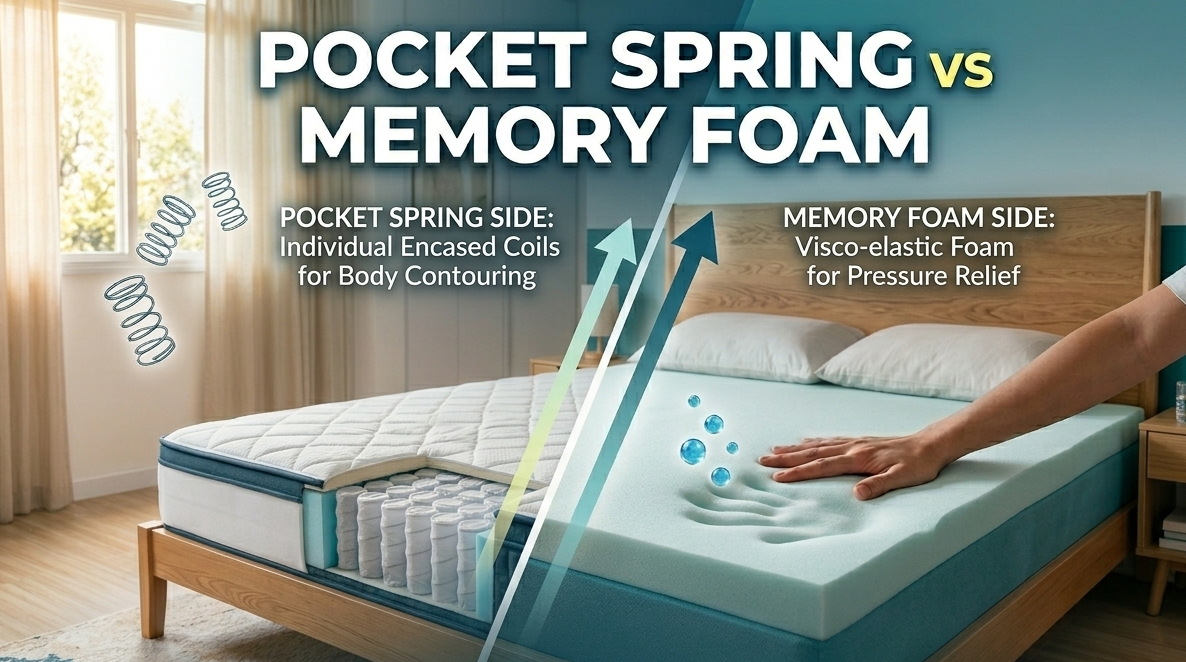 Pocket Spring vs Foam: Which Do Physiotherapists Prefer and Why
For back pain specifically, most physiotherapists and sports medicine professionals lean toward pocket spring over foam-only for the structural reasons outlined above: independent spring response, better pressure distribution, and longer support consistency.
This does not mean foam has no role. High-resilience foam comfort layers over a pocket spring base give you the contouring and pressure relief that springs alone cannot provide. The combination — pocket spring for structural support, quality foam for surface contouring — is the configuration most consistently aligned with what physiotherapists describe as appropriate for back care.
Latex is another material that physiotherapists often speak well of: it is naturally resilient, does not compress irreversibly under load, and responds to pressure without bottoming out. It is, however, considerably more expensive, which makes pocket spring hybrid the more accessible recommendation for most patients.
Memory foam alone presents a specific issue for back pain: it retains heat and responds slowly to position changes. Singapore's HDB bedrooms, particularly those without consistent air conditioning through the night, exacerbate the heat retention problem. Waking up overheated causes muscle tension — the opposite of the restorative environment back pain patients need.
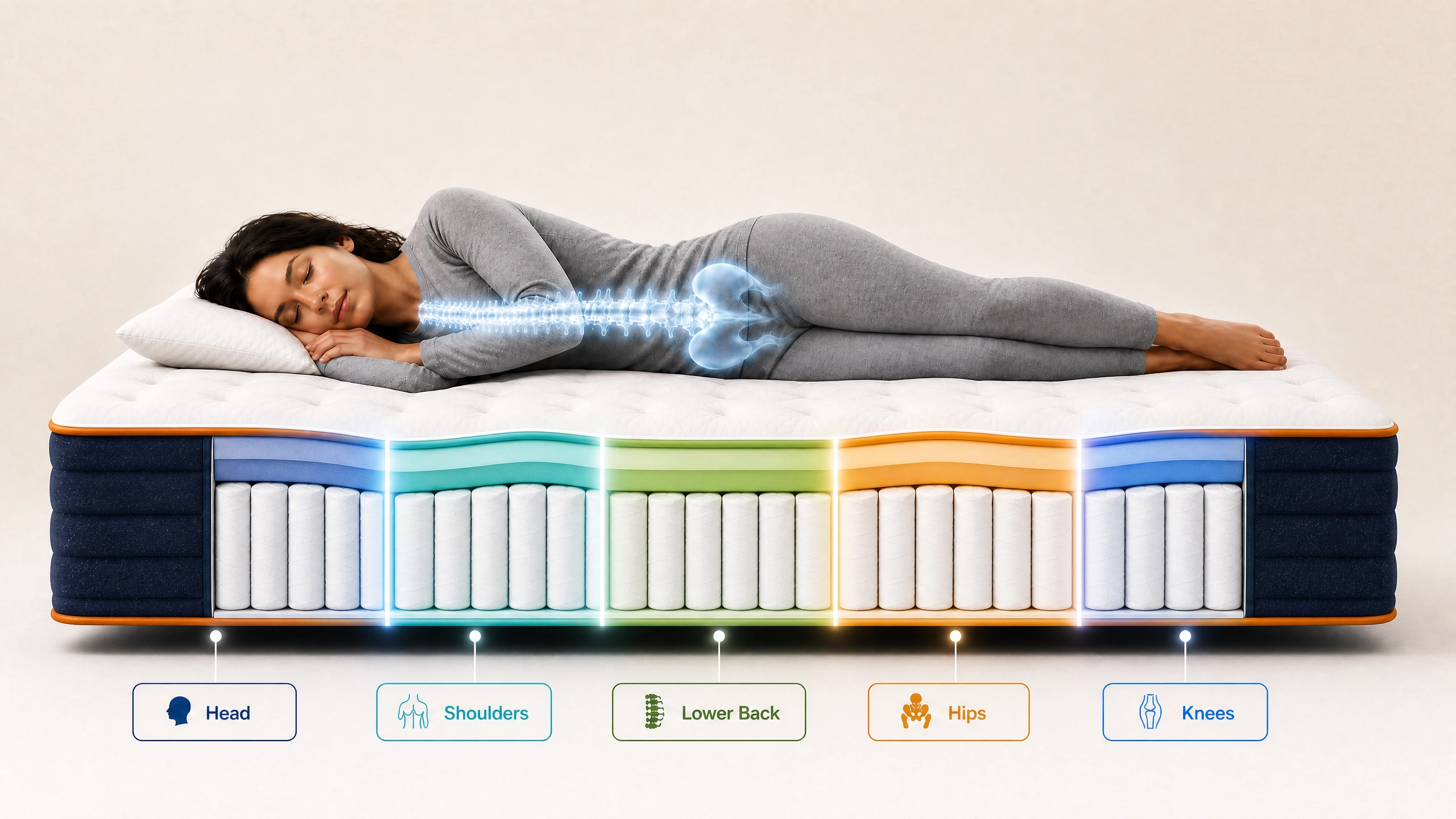
The Role of Zones — Why a 5-Zone System Is Closer to What Physio Recommends
The human body is not uniform in its support requirements. Your hips and shoulders are the heaviest and widest points. Your lumbar region is lighter but needs active support. Your feet and head require relatively little. A mattress with a single uniform firmness level is a compromise across all of these, acceptable for some, inadequate for many.
A zoned spring system assigns different spring tensions to different regions of the mattress. A 5-zone configuration typically designates firmer support at the shoulder zone and hip zone where you need both yielding and structural resistance, and a calibrated mid-zone for the lumbar region where the spine needs consistent underlift. Head and foot zones are typically softer, as the load there is minimal.
This maps closely to what a physiotherapist would prescribe if they were designing a sleep surface from scratch: more support where body mass concentrates, softer contouring where the spine is most vulnerable to unsupported gaps. It does not replicate a manual adjustment, but over the course of a night's sleep, the biomechanical difference is real.
The practical implication: if you have lower back pain and your current mattress has no zoning, your lumbar region is getting the same spring tension as your feet. That is a structural mismatch, and it's worth addressing.
What to Look For When Shopping: A Practical Checklist
- Pocket spring construction — independently wrapped coils that respond to individual pressure points, not a continuous coil system that moves as a unit
- Medium-firm or zoned firmness — not universally firm; the spec should match your primary sleep position
- Zoned support system — at minimum, a differentiated lumbar zone; ideally 5 zones across the full body length
- CertiPUR-US certified foam — verified material safety, especially relevant for foam comfort layers
- Cooling comfort layer — relevant for Singapore's climate; look for open-cell foam or fiber structures that don't trap heat
- Sufficient trial period — at least 90 nights; you cannot assess spinal adaptation in a showroom lie-down
- Warranty of at least 10 years — a signal of structural confidence from the manufacturer
- Ability to customise firmness by zone — especially useful if you and your partner have different body weights or sleep positions
One addition specific to WFH workers in Singapore: if you're spending 8–10 hours at a desk that isn't ergonomically set up, common in HDB apartments where the dining table doubles as a work surface, your lumbar spine is already accumulating load before you get into bed. A mattress that doesn't support proper lumbar positioning at night is compounding that daytime stress rather than recovering from it.
Owllight's 5-Zone System in Physiotherapy Terms
The Owllight Tulip Hybrid Mattress ($1,299 queen) was designed specifically around back care, the brand was founded because the founder had chronic back pain and couldn't find a mattress built specifically for it. That origin matters, because it means the spec decisions were made with clinical intent rather than comfort marketing.
In physiotherapy terms, here is what the Tulip Hybrid's features translate to:
5-zone pocket spring system: Independent springs across five body zones — shoulders, lumbar, hips, thighs, and feet — each calibrated to the load and support requirement of that region. The lumbar zone provides consistent underlift to prevent the spine from losing its neutral curve during the night. The shoulder and hip zones yield appropriately to reduce pressure and allow natural contouring without compromising structural support.
CertiPUR-US certified foam: The foam comfort layers have been independently tested for VOC emissions, formaldehyde, heavy metals, and ozone-depleting substances. Relevant for patients with respiratory sensitivities or chemical sensitivities, and for anyone sleeping in a climate-controlled room where air circulation is limited.
4D Air Fiber cooling layer: An open-structure fiber layer that allows airflow through the mattress surface rather than retaining heat at the sleep surface. In Singapore's climate, even with air conditioning, this addresses the thermal recovery problem that can disrupt sleep architecture and increase muscle tension through the night.
Customisable firmness per zone: The Tulip Hybrid allows you to adjust the firmness of individual zones independently. This is directly applicable to couples with different body weights or different primary sleep positions, a heavier partner may need a firmer hip zone to prevent excessive sinkage, while a lighter partner may need a softer shoulder zone for adequate pressure relief. A single uniform firmness cannot serve both correctly.
10-year warranty and 100-night trial: The warranty is a structural claim. The manufacturer is asserting that the support system will hold its performance over a decade of use. The 100-night trial is the minimum meaningful period to assess whether the mattress is working for your back. Spinal adaptation takes weeks, not days. Most back pain improvements from a mattress change will be evident within 30–60 nights; problems will also become apparent within that window.
The Tulip Hybrid is not a medical device. It does not treat back pain. But structurally, it addresses the four criteria physiotherapists use to evaluate a mattress for back care: zoned support, pressure distribution, long-term shape retention, and materials safety. Those criteria did not emerge from the marketing brief, they were the basis of the product design.
Frequently Asked Questions
Is there an officially "physiotherapist recommended" mattress in Singapore?
There is no official certification or endorsement body for mattresses in Singapore from the physiotherapy profession. Physiotherapists assess mattress suitability based on individual patient needs such as body weight, sleep position, existing conditions, and spinal history. When physiotherapists give general guidance, the consistent criteria are: medium-firm feel, pocket spring or latex construction, zoned support, CertiPUR-US certified materials, and a sufficient trial period to assess real-world results.
Is a firm mattress better for back pain?
No — at least, not as a universal rule. The research consensus has shifted away from "firm is best" toward "medium-firm is best for most people." Firm mattresses create pressure points at the hips and shoulders for side sleepers and can cause the lumbar spine to hang unsupported for back sleepers if the surface doesn't yield slightly in the right places. Medium-firm with zoned support is the more clinically defensible recommendation for the majority of back pain sufferers.
What is the difference between an orthopedic mattress and a regular mattress?
"Orthopedic mattress" is a marketing term, not a regulated clinical category. Any manufacturer can use it. What matters is the actual spec: spring type, zone configuration, foam density and certification, and structural durability over time. When evaluating any mattress marketed as orthopedic, look past the label and assess the construction — pocket spring with zoned support and CertiPUR-US foam is a meaningful spec; "orthopedic" as a standalone claim is not.
How long does it take to know if a mattress is working for your back?
Most people need 30–60 nights to accurately assess whether a mattress change is improving their back pain. The first week or two may feel different or even slightly uncomfortable as your body adapts to a different support profile — particularly if your previous mattress had developed body impressions. A trial period of at least 90–100 nights gives you enough time to get past the adaptation phase and assess real results. This is why a minimum 100-night trial is one of the practical criteria worth requiring before you buy.
The Tulip Hybrid meets all four physiotherapy criteria for a back care mattress.
5-zone pocket spring. CertiPUR-US certified foam. 4D Air Fiber cooling. Customisable firmness per zone. 100-night trial. 10-year warranty.
If you want to feel the zones before you commit, visit the Owllight showroom at 22 Sin Ming Lane, Singapore. Lie on each zone configuration. Bring your sleep position into the conversation — side, back, or stomach changes what you need from the spring tension.
See the Tulip Hybrid Mattress →
Singapore physiotherapists also flag pillow choice as load-bearing for spinal alignment - a properly contoured cervical pillow.
Physios in Singapore also flag overnight cooling as part of recovery — for sleepers who want cooling without replacing the mattress, the entry point is the 4D Air Fiber cooling topper.