
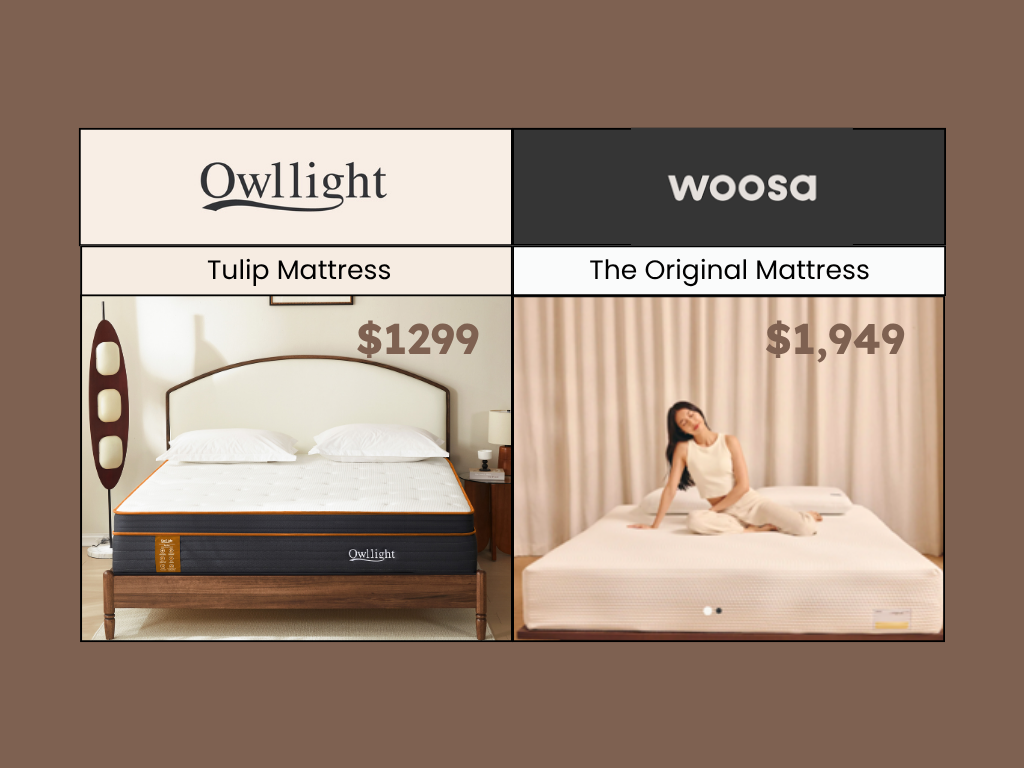
Disclosure: this comparison is published by Owllight. We are one of the two brands in it. Woosa details come from Woosa's own website, checked on 19 October 2026, and we have included its genuine strengths. A comparison written by an interested party is still more useful than no comparison, as long as you can check every number. Every Woosa figure below links to its source.
Woosa builds foam mattresses. Its range runs from the Original at S$1,549 through the Terra at S$1,749 to the Mysa at S$1,949, built from Sonocore latex, memory foam and a Silver Microtencel cover made in Italy. The Owllight Tulip is a hybrid at S$1,099 to S$1,399, using 5-zone pocket springs under a 4D Air Fiber layer. If you want a latex-and-foam feel with no spring response, Woosa does that well. If you want zoned support under the lower back, springs for airflow, and 100 nights at home instead of 30, the Tulip is built for that.
By Tina Zou Yan, Founder, Owllight Sleep
Woosa vs Owllight: the numbers side by side
| What you are comparing | Woosa | Owllight Tulip Hybrid |
|---|---|---|
| Models | Three: Original, Terra, Mysa (Mysa also in Plush) | One, in two firmness options |
| Price | From S$1,549 (Original), S$1,749 (Terra), S$1,949 (Mysa) | S$1,099 single to S$1,399 king |
| Construction | Foam and latex; microcoils in the Mysa only | 5-Zone Pro-S pocket springs plus 4D Air Fiber and cooling foams |
| Zoned support | Not stated as zoned | 5 zones, firmer under the lumbar region |
| Depth | 30.5 cm across the range | 30 cm |
| Cover | Silver Microtencel, designed in Belgium, made in Italy, 385 GSM | Aerosilk Tencel |
| Cooling approach | Open-cell latex and a breathable cover | Airflow through the 4D Air Fiber layer and the spring cavity, plus cooling foams |
| Home trial | 30 nights | 100 nights |
| Edge | Not stated | 8 cm reinforced edge |
| Certification | Not stated on the range page | CertiPUR-US on the foam layers, OEKO-TEX on the textiles |
| Where to try | Woosa showroom | Owllight showroom, by appointment |
What is inside a Woosa mattress?
Woosa has moved its site to woosasleep.co, and its range page opens with its position plainly: "Say hello to a springless future." Its mattresses are built from foam and latex rather than coils.
The Original, from S$1,549, is medium firm. It stacks 5 layers: a Silver Microtencel cover, Sonocore Natural Pulse latex, Aer-Memory Foam, a high-resilience transition foam and a high-density base foam. It is 30.5 cm deep and weighs from 28 kg. Woosa recommends it for back or side sleepers, and for anyone trying a full-foam mattress for the first time.
The Terra, from S$1,749, is the firm option. It uses 2 layers of Sonocore latex above the memory foam, which Woosa describes as creating an extra-firm surface aimed at posture and muscle recovery. Woosa suggests it for back sleepers or heavier side sleepers, and notes that a firmer surface makes it easier to move around on and to get in and out of bed.
The Mysa, from S$1,949, is the softer one, also sold as the Mysa Plush. This is where the springless description needs a footnote: Woosa's own Mysa page lists high-density sublayers and "tiny microcoils" that "offer enhanced lift support to eliminate the sensation of over sinking" (Woosa Mysa). So the range is foam-led, but the Mysa is not strictly springless.
Woosa publishes real detail on its cover, which is rare enough to mention. Silver Microtencel is designed in Belgium and made in Italy, weighs 385 GSM, and each thread is 3 times finer than a standard thread. The silver gives it anti-microbial properties and the knit allows airflow. It is a genuinely nice fabric and we are not going to pretend otherwise.
How the support actually differs

This is the part most comparisons skip, and it is the only part that matters if your back hurts.
A foam-and-latex stack supports you by compressing. Press anywhere and the material under that point gives way, and the material beside it gives way a little too, because foam is continuous. The whole surface behaves roughly the same from head to foot. Firmness changes how much it gives, not where.
A zoned pocket spring supports you by region. Each coil sits in its own fabric pocket and moves on its own, and the coils are not all the same. In the Tulip, the springs under the lumbar region are firmer than the springs at the shoulders. So your hips are held up while your shoulders are allowed to settle in, and your spine stays closer to the line it holds when you stand.
That difference is the whole reason we build a hybrid rather than a foam mattress. It is not that foam is bad. It is that a uniform surface cannot do two different jobs at two different points along your body. If you wake with a stiff lower back, that is usually what went wrong. Our guide to pocket spring against memory foam goes through the mechanics, and why your back hurts every morning helps you work out whether your mattress is the cause before you replace anything.
Where Woosa's approach wins: motion isolation is excellent in foam, there is no spring noise ever, and a latex surface has a bounce-free, settled feel that some people strongly prefer. If you have slept on foam and liked it, a hybrid may feel unfamiliar at first.
Which one sleeps cooler in Singapore?

Both brands take humidity seriously, and they solve it differently.
Woosa works on the surface and in the material. The Microtencel cover wicks moisture quickly and the open-cell structure of Sonocore latex lets some air move. The Mysa page describes heat being drawn through the open-cell foams and channelled through the microcoils.
The Tulip works on the cavity. Above the springs sits a 4D Air Fiber layer, an open structure that is mostly air, so heat has somewhere to go rather than being held against your body. Below it, the gaps between pocket springs act as a chimney. The cooling foams and the Tencel cover handle the surface. The 4D Air Fiber material is Japanese in origin, and our own measurements of it are taken at the point where your body contacts the mattress.
Honestly: both will be cooler than a dense memory-foam mattress with a quilted top. Between the two, a hybrid has a structural advantage because air can move through the spring layer, and a foam stack has to move heat through material. Whether you notice that depends on how hot you sleep. Our guide for hot sleepers explains how to tell surface cooling from airflow cooling when you are lying on something in a showroom for 10 minutes.
Price, trial and the terms around them
Woosa's range starts at S$1,549 for the Original and runs to S$1,949 for the Mysa. Woosa lists free shipping, local Singapore support, a quality-assured warranty and a 30-night home trial. It was running 10% off mattress-and-base bundles when we checked.
The Tulip is S$1,099 for a single, S$1,199 for a super single, S$1,299 for a queen and S$1,399 for a king. Medium Firm at 7 to 8 is held in stock; an Extra Firm at 9 to 10 is made to order for an extra S$30, with no ready stock, so confirm timing before ordering. It comes with free standard Singapore delivery, usually two to three days for in-stock sizes, a 100-night home trial and a 10-year limited warranty. Its foam layers are CertiPUR-US certified and its textiles are OEKO-TEX certified.
The trial length is the gap worth thinking about. 30 nights is enough to know whether you like a mattress. It is not always enough to know whether your back has settled, because a body adjusting to new support can ache for the first 2 or 3 weeks before it improves. 100 nights covers that adjustment with room to spare.
Which should you choose?

Choose Woosa if you have slept on foam and liked it, you want a latex feel with no spring response at all, you share a bed with someone restless and motion isolation is your first priority, or the Italian-made cover and the finish matter to you. The Terra in particular is a considered firm mattress, not just a hard one.
Choose the Tulip if your lower back is the reason you are shopping, you want support that changes under the hips rather than a single firmness everywhere, you sleep hot and want air moving through the mattress, or you want a longer trial because you are not sure yet. It is also between S$450 and S$850 cheaper depending on the models you compare.
Still unsure? Try both in person. Woosa has a showroom and so do we. Ten minutes lying in your own sleeping position tells you more than any comparison table, including this one. If you want to know what to pay attention to while you are there, see the showroom page for how to arrange a visit.
Frequently Asked Questions
How much does a Woosa mattress cost in Singapore?
On Woosa's own site on 19 October 2026, the Original started at S$1,549, the Terra at S$1,749 and the Mysa at S$1,949. Woosa was also running 10% off mattress-and-base bundles. Prices change, so check its site before you buy.
Does Woosa use pocket springs?
Mostly no. Woosa describes its range as springless, and the Original and Terra are built from foam and latex. The exception is the Mysa, whose product page lists tiny microcoils alongside high-density sublayers. So it is a foam-led range with one model that includes coils.
Is Woosa or Owllight better for back pain?
For a sore lower back, zoned support is the thing to look for, and that is where the two differ. The Tulip's pocket springs are firmer under the lumbar region than at the shoulders, so support changes along your body. Woosa's foam and latex stack applies a consistent feel across the whole surface. Both are comfortable mattresses; only one varies its support by region.
How long is Woosa's trial compared with Owllight's?
Woosa offers a 30-night home trial. Owllight offers 100 nights. If you are buying to fix back pain, the longer window matters, because a body adapting to new support can feel worse for 2 or 3 weeks before it feels better.
Is the Owllight Tulip cheaper than a Woosa?
Yes, at every comparison point we could check on 19 October 2026. The Tulip runs S$1,099 to S$1,399 across sizes. Woosa's cheapest mattress, the Original, started at S$1,549, and its Mysa at S$1,949.
Where can I try a Woosa or an Owllight mattress in person?
Both brands have a Singapore showroom. Ours is self-guided, and we ask you to check availability and make an appointment first so we can confirm whether a team member will be there to help. Details are on the showroom page.
Has Woosa changed its website?
Yes. The old woosa.sg address now redirects to woosasleep.co. If you have an older comparison bookmarked, check that its prices and model names still match what Woosa lists today, because the range and the pricing have both moved.
Where this leaves you
Woosa makes a genuinely good foam mattress with a better cover than most, and the Terra is a thoughtful firm option. We would not argue with anyone who bought one.
But if you came to this page because your back hurts in the morning, the thing to compare is not the layer count or the fabric weight. It is whether the mattress supports your hips differently from your shoulders. That is what we built the Tulip to do, at a lower price, with 100 nights to find out whether it works for you. You can check current Tulip sizes and prices, or read the full Tulip review first.
Last updated 20 October 2026. Woosa prices, models and website address were checked on 19 October 2026 and change often.