.png?w=615&h=171)

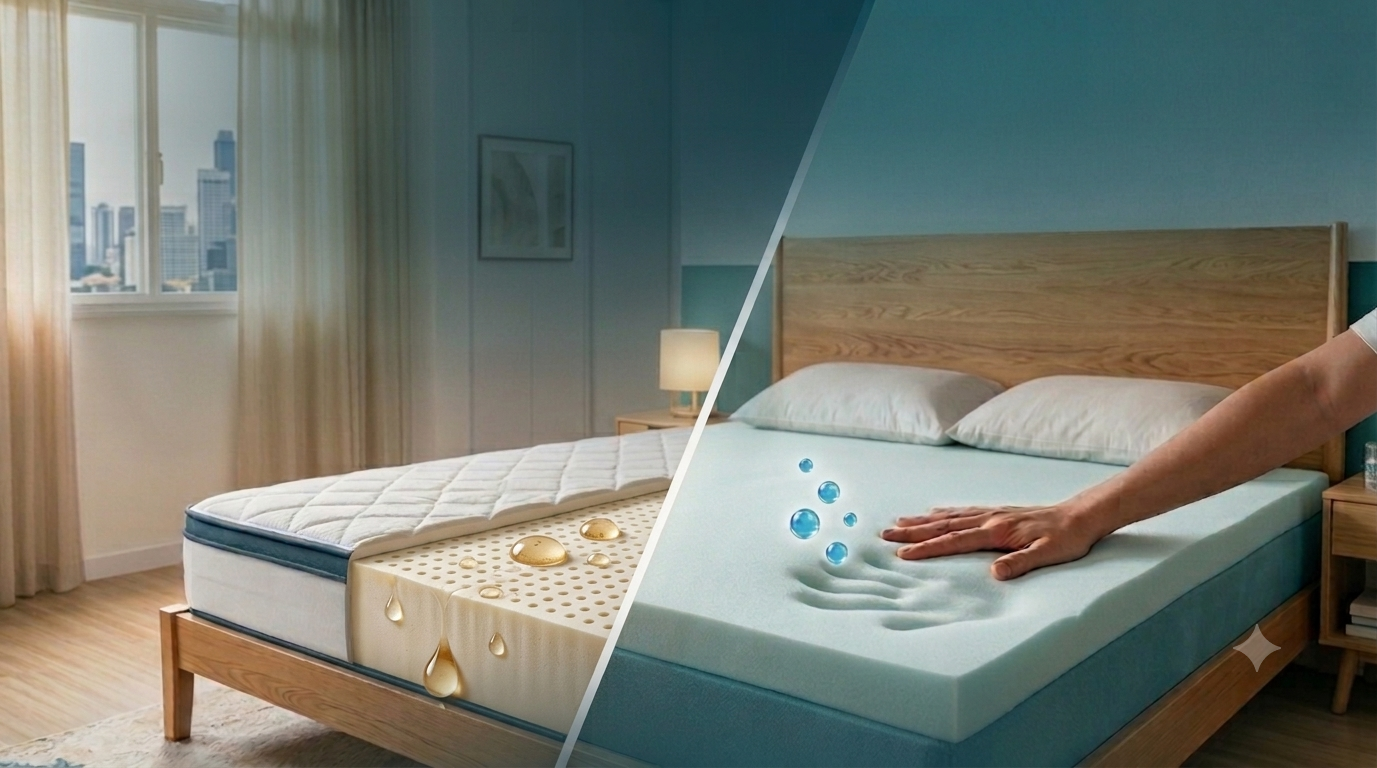
Memory foam moulds to your body and absorbs motion well, but it traps heat — a real drawback in Singapore's humidity. Latex is bouncier, cooler, naturally more durable, and a good fit if you sleep hot or want a responsive feel, but it costs more and is heavy. Neither is "better" outright; it depends on your sleeping position, how hot you sleep, your budget, and whether you have allergies. If you want zoned back support plus genuine airflow, a hybrid — pocket springs with the right comfort layer on top — usually fits Singapore better than either solid material alone. Here's the full breakdown.
If you're mattress shopping in Singapore, you'll hit the memory foam vs latex question fast. Both are sold as the "comfortable" choice. Both contour to your body. And most product pages won't tell you the trade-offs honestly — they're written to sell whichever one the brand stocks.
So here's a straight comparison, grounded in how each material actually behaves over a full night in Singapore's climate.
How Memory Foam Works
Memory foam is a viscoelastic material — it reacts to both pressure and temperature. Where your body makes contact, it softens and slowly moulds to your outline over the first 10–15 minutes of lying down. When you move, it gradually returns to shape.
That contouring is the appeal. It creates a cradling, hugged feeling, and for people with pressure point pain — sore hips, tender shoulders — the relief is immediate. Memory foam also absorbs motion very effectively, so a partner shifting at 3am is unlikely to wake you.
The catch is what happens across the rest of the night. Memory foam provides passive conformity, not active support. It follows your body's shape — whether that shape is well-aligned or not — and its closed-cell structure limits airflow, so heat builds up at the contact surface.
How Latex Works
Latex is a different feel entirely. Instead of slowly sinking, it responds and pushes back — bouncy, springy, supportive. You rest more on top of latex than inside it. There's no "stuck in the mattress" sensation that some people dislike about memory foam.
There are two types. Natural latex comes from rubber tree sap and is the more durable, breathable option. Synthetic (or blended) latex is cheaper and mimics the feel, but doesn't last as long or breathe as well. The manufacturing process also matters: Talalay latex is softer and more consistent, Dunlop latex is denser and firmer. If a Singapore retailer can't tell you which type and process you're buying, that's worth pausing on.
Latex's open structure means it allows more airflow than solid memory foam, and natural latex is inherently resistant to dust mites and mould — useful in a humid climate. The downside: it's heavy, it costs more, and the bouncier feel isn't for everyone.

The Heat Problem — Why This Matters More in Singapore
This is where the comparison stops being academic. Singapore's ambient humidity sits above 80% for much of the year, and most bedrooms run air-conditioning that dries the air rather than fully removing the heat your body generates overnight.
Solid memory foam works against you here. Its closed-cell structure traps body heat at the surface, and many people who sleep on it report waking up damp or sweaty. Gel-infused and open-cell memory foam formulations improve this — but they reduce the problem, they don't remove it.
Latex breathes better. The pinhole structure in moulded latex allows more vertical airflow, and natural latex in particular runs cooler than solid memory foam. It's not a cold surface, but in a side-by-side test in Singapore's climate, latex generally sleeps cooler than traditional memory foam.
Worth knowing: neither solid material matches the airflow of an open coil layer or an open-cell fibre. A mattress built with pocket springs, or a topper built on something like 4D Air Fiber — an open-cell polymer fibre that's roughly 95% air by volume — moves heat away from the sleeper more aggressively than either foam or latex on its own.
Support and Back Care
Both materials can feel supportive, but they support differently, and this is the part that matters most if you wake up with a stiff lower back.
Memory foam distributes weight evenly and relieves pressure points, but it doesn't distinguish between body zones. Your lumbar region — which needs different support from your hips — gets the same surface response. If your posture is already compromised from long hours at a desk, solid memory foam tends to mirror that misalignment through the night rather than correcting it.
Latex offers firmer, more uniform pushback, which keeps you more "on top" of the surface and can feel more supportive for back and stomach sleepers. But uniform latex still applies one response across the whole body, the same limitation in a different form.
What actually addresses back alignment systematically is zoned support — firmer under the lumbar region, softer under the shoulders and knees — which neither solid foam nor solid latex provides on its own. That's a structural job a zoned pocket spring system does. None of this is a medical claim: a mattress can support better sleeping posture, but persistent back pain is worth raising with a healthcare professional rather than treating as a mattress problem alone.
Durability, Allergy, and Price
Durability favours latex. Natural latex is one of the longest-lasting mattress materials — often 10–15 years before it noticeably degrades. Memory foam typically holds up 6–8 years before body impressions start to set in, and lower-grade foam degrades faster, especially in heat and humidity.
On allergies, natural latex is inherently resistant to dust mites and mould, which is a genuine plus in Singapore's humidity. The important caveat: people with a latex allergy should avoid natural latex entirely, or choose a synthetic blend after confirming the content. Memory foam isn't a natural allergen, but lower-grade foam can off-gas more noticeably when it's new — which is why independent certification like CertiPUR-US matters; it tests foam for emissions and harmful materials rather than relying on a manufacturer's word.
On price, memory foam is generally the more affordable entry point. Natural latex sits at the premium end. In the middle sit hybrids and quality foam mattresses, and this is where "cheapest" and "best value" stop being the same thing — a low-priced solid foam mattress that traps heat and sags in three years isn't cheaper over its life than a better-built mattress that lasts a decade.
Side by Side: What Each Does Well
| Feature | Memory Foam | Latex |
|---|---|---|
| Feel | Slow-sinking, contouring, cradling | Responsive, bouncy, rest on top |
| Cooling | Traps heat — improved by gel/open-cell but not resolved | Cooler — natural latex breathes well |
| Pressure relief | Excellent — the material's main strength | Good, but firmer and less cradling |
| Support | Passive conformity — follows your shape | Firmer uniform pushback — feels more supportive |
| Durability | 6–8 years before impressions develop | 10–15 years for natural latex |
| Motion transfer | Very low — foam absorbs movement | Low to moderate — bounce carries some movement |
| Allergy | Neutral — but check off-gassing / certification | Dust-mite resistant — but avoid if latex-allergic |
| Weight | Moderate | Heavy — harder to move and rotate |
| Price | More affordable entry point | Premium, especially natural latex |
Where Hybrid Fits
For a lot of Singapore sleepers, the honest answer isn't memory foam or latex — it's a hybrid, because neither solid material solves the two problems that matter most here at the same time: zoned back support and genuine cooling.
A hybrid pairs a pocket spring core with comfort layers on top. The springs do the structural work — independent coils respond to localised weight, and a zoned layout maps firmer support under the heavier hip and shoulder zones and softer support under the lumbar and leg zones, so your spine stays neutral. The open space between coils also lets air circulate, which solid foam and solid latex can't match.
What sits above the springs is what tunes the feel. A hybrid can carry foam comfort layers, latex, or an open-cell cooling fibre — so you can get the contouring people like about memory foam, or the responsiveness people like about latex, without inheriting the heat retention of a solid block of either.
If cooling is your priority, look at what the comfort layer is actually made of. Our cooling mattress topper guide breaks down the airflow differences in more detail, and the pocket spring vs memory foam comparison covers the support side.

Picture: Owllight Tulip Hybrid Mattress in a Box
The Owllight Approach
We built the Tulip Cooling Back Care Mattress as a hybrid because the two things Singapore sleepers ask about most — a back that doesn't ache in the morning, and a mattress that doesn't sleep hot — are hard to solve with foam or latex alone.
It uses a 5-zone pocket spring system: firmer coils under the hips and shoulders, softer under the lumbar zone, so the spine stays in neutral alignment through the night. Above the springs sit cooling foam layers and a 4D Air Fiber layer — the open-cell fibre that handles Singapore's humidity through structural airflow rather than a chemical surface treatment. The foam layers are CertiPUR-US certified, which matters in this climate because lower-grade foam off-gasses more noticeably in heat and humidity.
It's not the only right answer. If you specifically want the bounce of natural latex, or the deep cradle of solid memory foam, those are valid preferences. But if you're weighing the two mainly because of back support and heat, a hybrid is usually the more complete fit for Singapore — and the 100-night trial means you can test whether it actually changes your mornings before you commit.
See the Tulip's full spec and current pricing →
Who Should Choose What
Choose memory foam if: You want a deep contouring, cradling feel. Pressure point relief (hips, shoulders) is your main concern. You sleep alone or are a very light sleeper sensitive to movement. You're working to a tighter budget — and you accept it may sleep warmer.
Choose latex if: You prefer a responsive, bouncy surface. You sleep hot and want a cooler material. You want long durability and natural dust-mite resistance. You're not latex-allergic, and the premium price is workable.
Choose a hybrid if: You want zoned back support and real airflow — which is most Singapore sleepers. You share a bed. You sleep hot. You want a comfort layer you can match to your preferred feel without giving up the structural support of a spring core.
Looking for Something Tailored?
If you have a non-standard bed frame, an unusual size, or specific firmness needs, an off-the-shelf mattress isn't always the fit. We cover bespoke options in our custom mattress Singapore guide.
FAQ
- Is memory foam or latex better for hot sleepers in Singapore?
- Latex is generally cooler. Its open pinhole structure allows more airflow, while solid memory foam traps heat at the contact surface — a bigger problem in Singapore's humidity than in drier climates. For the coolest result, a mattress with an open coil layer or an open-cell cooling fibre moves heat away better than either solid material alone.
- Which lasts longer, memory foam or latex?
- Latex. Natural latex often holds its shape 10–15 years; memory foam typically lasts 6–8 years before body impressions develop. Heat and humidity shorten the lifespan of lower-grade foam, so durability is worth weighing in Singapore.
- Is latex better than memory foam for back pain?
- Latex gives firmer, more uniform support that some back and stomach sleepers prefer. But neither solid material provides zoned support — firmer under the lumbar, softer under the shoulders and knees — which addresses spinal alignment most directly. A zoned pocket spring hybrid does that. A mattress supports posture; persistent back pain is best raised with a healthcare professional.
- Is latex or memory foam more expensive in Singapore?
- Memory foam is the more affordable entry point; natural latex is premium. Hybrids sit in between. The cheapest option isn't always best value — foam that traps heat and sags in a few years can cost more over its life than a better-built mattress that lasts a decade.
- Can I be allergic to a memory foam or latex mattress?
- Natural latex resists dust mites and mould — useful in humidity — but anyone with a latex allergy should avoid it or choose a confirmed synthetic blend. Memory foam isn't a common allergen, though lower-grade foam can off-gas when new, which is why independent certification like CertiPUR-US matters.