.png?w=615&h=171)

The best mattress for couples in Singapore is one that handles motion transfer, supports two different sleep positions, and doesn't trap heat for either person. A zoned pocket spring hybrid — with independent coils and breathable comfort layers — is the practical answer for most couples. If you and your partner have genuinely different firmness needs, a mattress with a customisable firmness option removes the compromise entirely.
Buying a mattress when you live alone is straightforward. You know your sleep position. You know whether you sleep hot. You test it, decide, and buy.
Buying a mattress as a couple is a different problem. One of you is a side sleeper who needs a softer surface. The other sleeps on their back and wants something firmer. One runs warm all night. The other is pulling the duvet back on at 2am. One moves in their sleep. The other wakes up at the slightest disturbance.
Finding a single mattress that works for both of you — in Singapore's climate, in an HDB bedroom that often doesn't fit anything bigger than a queen — is not as simple as splitting the difference.
Here's what actually matters, and how to make a decision you'll both be happy with for the next 8 to 10 years.
The Four Things That Actually Matter for Couples
1. Motion Transfer
If your partner moves in their sleep, you feel it. On a bonded spring or innerspring mattress, movement on one side creates a ripple across the entire surface. This is the most common sleep disruption couples report — and it's entirely solvable at the mattress level.
Independent pocket springs are the key. Because each coil is individually wrapped in its own fabric pocket, springs respond only to the weight directly above them. Movement on your partner's side compresses their springs — yours remain still. The difference between an independent pocket spring system and a bonded spring is dramatic; most people notice it on the first night.
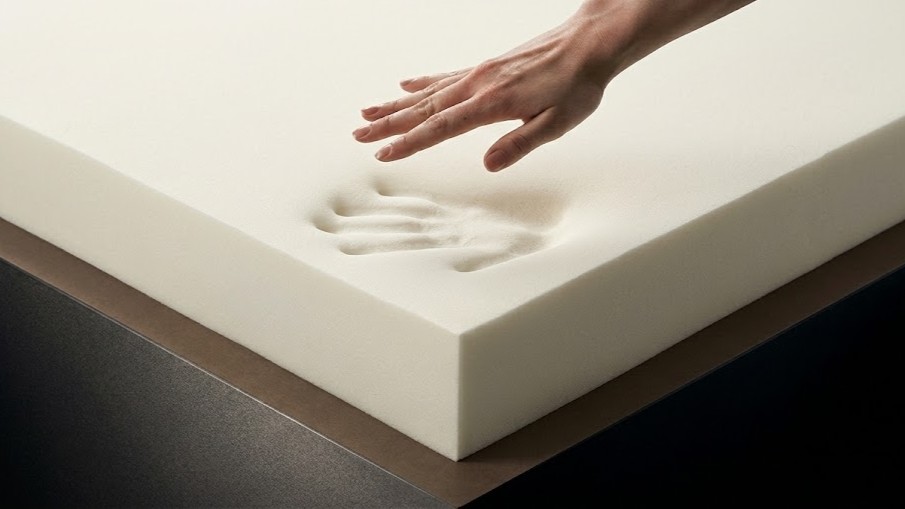
Memory foam also handles motion transfer well, but for couples in Singapore, the heat retention trade-off is usually not worth it. More on that below.
2. Edge Support
In a Singapore HDB bedroom, a queen bed often leaves you 50–70cm of clearance on each side. Couples end up sleeping closer to the edges than they would in a larger room.
Mattresses with weak edge support create a compressed, unstable surface when you're not lying dead centre. You either avoid the edge — which means crowding toward the middle — or you roll toward it and feel unsupported. A pocket spring system with good perimeter reinforcement gives you usable sleep surface all the way to the edge. Both of you get a full half of the bed, not a slightly narrowed half.
3. Temperature (Both of You)
Couples rarely run at the same temperature. One partner sleeps hot; the other is comfortable or cold. This asymmetry is real and physiological — it's not something you can resolve by adjusting the air-conditioning, which affects both of you equally.
What you can control is the mattress. A breathable sleeping surface — one that allows air to circulate rather than trapping body heat — helps the warmer sleeper without penalising the cooler one. The cooler partner can add a layer (a duvet, a light blanket); the warmer partner can't shed a hot mattress.
This is one reason why Singapore couples should be particularly cautious about solid memory foam mattresses. The heat retention that's mildly inconvenient for a single sleeper becomes a more acute problem when two people are generating heat on the same surface.
4. Support for Two Different Sleep Positions
This is the most structurally complex challenge.
A side sleeper needs the hip and shoulder to sink enough for the spine to remain straight — too firm a surface creates lateral lumbar strain. A back sleeper needs the lumbar to maintain contact with the mattress — too soft a surface lets it sag into a curve. If one of you sleeps on their side and the other on their back, you need a mattress that provides genuinely different support profiles across different zones.
A zoned pocket spring system addresses this better than a uniform surface — firmer tension under heavy zones, softer tension under the lumbar — because it responds to each person's weight distribution independently across the whole surface. You're not both fighting the same compromise.
What About Different Firmness Preferences?
Some couples have genuinely incompatible firmness preferences. One person finds medium-firm ideal; the other needs something softer because of hip or shoulder pressure. In this case, a single-firmness mattress will always leave someone underserved.
There are two realistic solutions:
1. Customisable firmness. Some mattresses allow each half of the bed to be built at a different firmness level. This removes the compromise entirely — both people sleep on the firmness that works for them, on the same mattress. Owllight's customisable firmness option on the Tulip Hybrid is built for exactly this. You specify the firmness independently for each half at the point of order.
2. Two singles instead of one queen. Two single mattresses placed in a king-size frame let each person sleep on an entirely independent surface. This is common in Scandinavia and increasingly adopted in Singapore for couples with dramatically different needs. The trade-off is a join line down the middle — manageable with the right mattress topper, but worth knowing about.
If your preferences are within one firmness category of each other (e.g. one of you wants medium, the other medium-firm), a good zoned mattress usually accommodates both. If you're more than one category apart, customisable firmness is the more practical answer.
HDB-Specific Considerations
Most couples in Singapore sleep on a queen (153cm × 190cm). Some upgrade to a king (180cm × 190cm) when the room allows it. A few things worth knowing:
Queen vs King: A queen gives each person roughly 76cm of width — comfortable for solo sleeping but tight for couples who move in their sleep or prefer space. A king adds 27cm total (about 13cm per person), which sounds small but meaningfully reduces the chance of disturbing each other. If your room can fit a king, it's worth considering.
Room clearance: Standard HDB bedrooms range from about 9sqm to 12sqm for master rooms. At 12sqm, a king fits comfortably. At 9sqm, a queen with adequate clearance on both sides is the practical limit. Measure twice — a mattress purchase is not easily reversed.
Bed frame compatibility: Slatted frames work with most pocket spring mattresses. If slats are spaced more than 7cm apart, add a support board or look for a mattress with its own structural perimeter — otherwise the coils at the edges will sag into the gaps over time.
The Owllight Answer for Couples
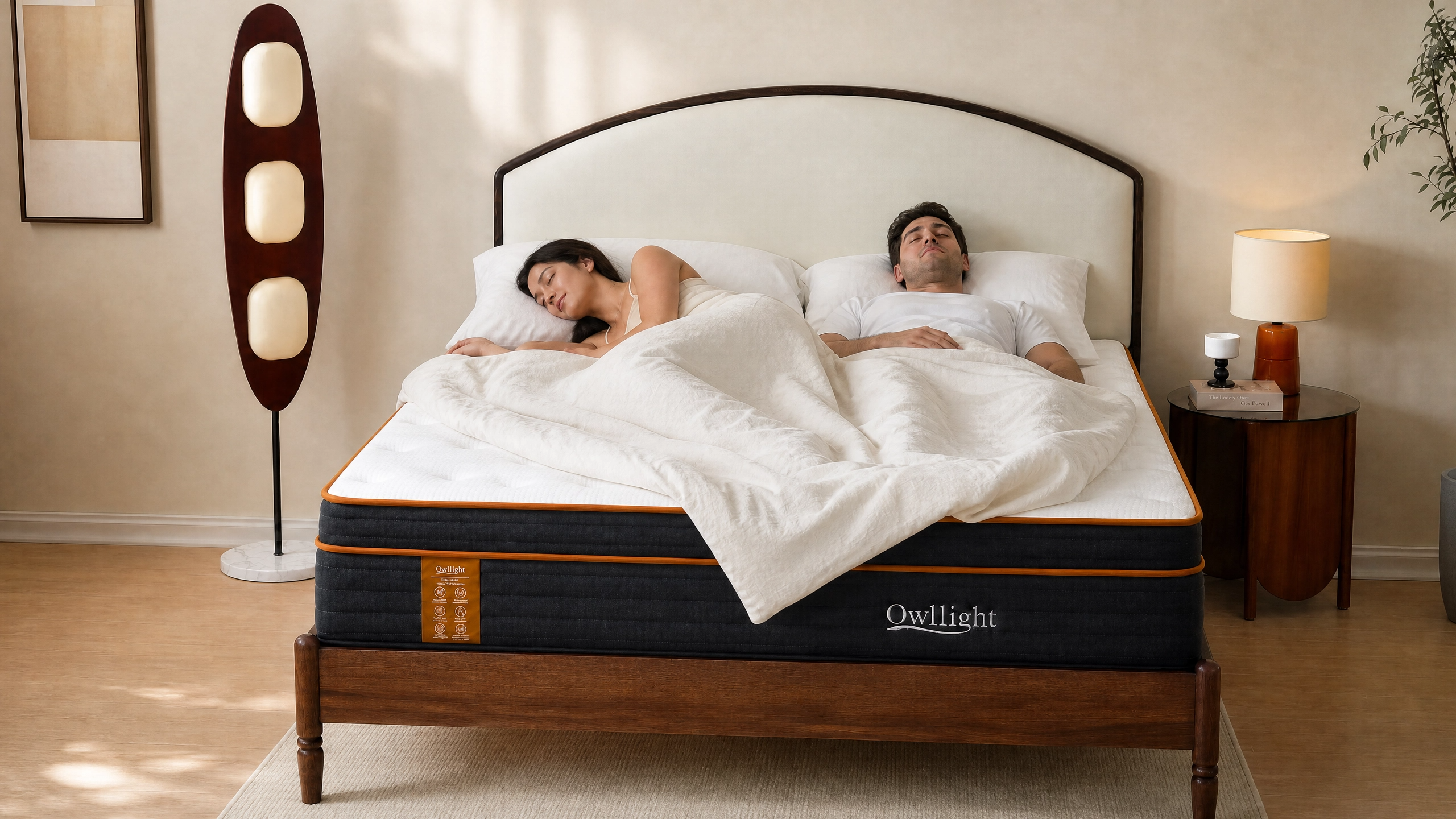
The Tulip Hybrid handles the three biggest couple-specific challenges: independent pocket springs minimise motion transfer, the 5-zone construction provides support that adapts to different sleep positions across the surface, and the 4D Air Fiber layer keeps the sleep surface breathable for the warmer sleeper.
The customisable firmness option means couples with different preferences don't need to compromise — each half of the mattress is built to the firmness you specify.
The 100-night trial applies to both of you. If one person is consistently uncomfortable after 30–40 nights, that's useful information — and still within the return window.
See the Tulip Hybrid — including customisable firmness options →
If only one partner needs firmer support, the cheaper fix is the 3D Back Care extra-firm topper.
Quick Reference: What to Prioritise
| Your Situation | What to Prioritise |
|---|---|
| One partner moves a lot in sleep | Independent pocket springs — non-negotiable |
| Different sleep positions (e.g. side + back) | Zoned pocket spring system — adapts per zone |
| One partner sleeps significantly hotter | Breathable top layer — avoid solid foam |
| Different firmness preferences (>1 category apart) | Customisable firmness — split per side |
| Small HDB room, queen only | Strong edge support — usable surface to the edge |
| One or both partners have back pain | Zoned support + back-care construction first |
FAQ
- What is the best mattress for couples in Singapore?
- A zoned pocket spring hybrid handles the core couple-specific challenges: independent coils minimise motion transfer, zoned support adapts to different sleep positions, and breathable construction works with Singapore's climate. For couples with significantly different firmness preferences, a customisable firmness option removes the compromise entirely.
- How do I choose a mattress if my partner and I have different firmness preferences?
- If you're within one firmness category of each other (e.g. medium vs medium-firm), a good zoned mattress usually works for both. If you're further apart, look for customisable firmness per side — where each half is built to each person's preference independently. Owllight's Tulip Hybrid offers this at the point of order.
- Does motion transfer really matter for couples?
- It's the most commonly reported sleep disruption between partners. On a bonded spring system, movement ripples across the surface. Independent pocket springs contain movement to the coils directly beneath the person moving, leaving the rest undisturbed. The difference is immediately noticeable.
- Should couples in Singapore buy a queen or king?
- If the room can accommodate it, a king gives each person meaningfully more space and reduces the chance of disturbing each other. In most HDB master bedrooms, a queen is the practical limit. Measure including clearance on both sides and at the foot before deciding.