.png?w=615&h=171)

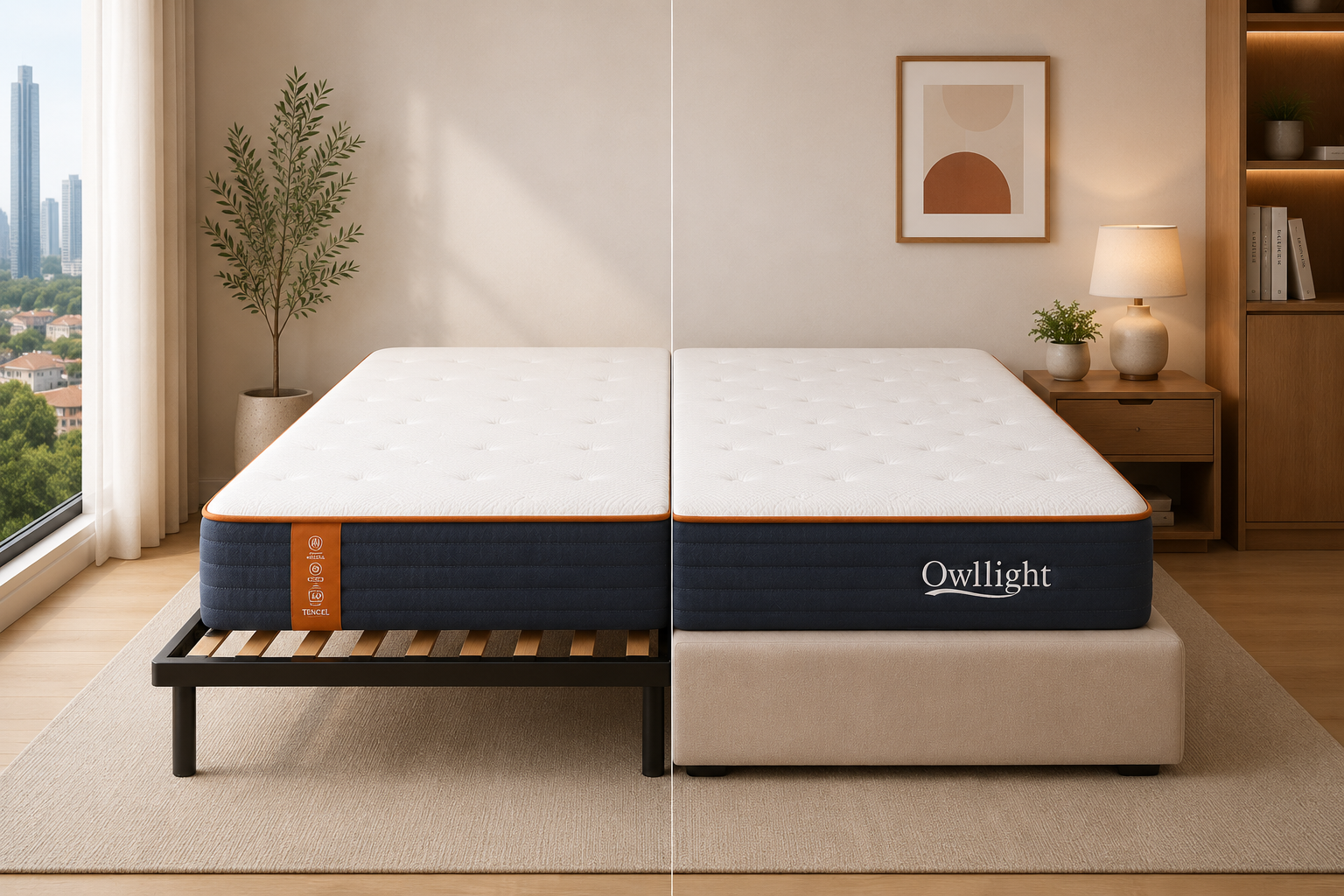
In Singapore, the choice comes down to airflow versus storage. A bed frame with slats lets air move under your mattress, which matters in our humidity — but gives you no storage. A divan base is a solid upholstered box that hides storage drawers and feels more stable, but it restricts airflow underneath. For most HDB bedrooms tight on space, a divan with side drawers wins on practicality. For hot sleepers and mould-prone rooms, a slatted frame wins on ventilation. The base you pick also affects how firm your mattress feels and how long it lasts. Here's the full breakdown.
You spend weeks choosing a mattress, then pick the base in five minutes at the shop. That's the wrong order for a Singapore bedroom — the base sitting under your mattress changes how it feels, how cool it sleeps, and how long it lasts before it starts to sag.
So here's a direct comparison of bed frames and divan bases, grounded in how each one works under your mattress and what actually matters in an HDB or condo flat.
What Is a Bed Frame?
A bed frame is an open structure — a headboard, side rails, legs, and a flat surface across the middle that holds the mattress. That middle surface is usually wooden or metal slats spaced a few centimetres apart, though some frames use a solid platform or a mesh.
The defining feature is the open space underneath. Air moves freely under the mattress, and depending on the leg height, you get clearance you can use for low storage boxes or simply leave open for cleaning.
Slat spacing matters more than most people realise. Slats spaced too far apart let a softer mattress dip between them over time. For a pocket spring or hybrid mattress, slats should sit no more than around 7cm apart to support the coils evenly — wider gaps and you risk uneven wear and a voided warranty on some mattresses.
What Is a Divan Base?
A divan base is a solid, upholstered rectangular box that the mattress sits on top of. Instead of open slats, it's a fully enclosed platform — usually a timber frame wrapped in fabric, sometimes with a sprung top layer.
Because the base is a closed box, it sits flush to the floor or on short legs, and the inside of the box can be built into storage. This is where divans earn their place in Singapore: the box becomes drawers or a gas-lift compartment, turning the dead space under your bed into usable storage without adding a single centimetre to the room's footprint.
There are two common divan tops. A platform-top divan has a firm, solid surface — it makes the mattress feel firmer. A sprung-edge divan has a layer of springs in the base itself, which adds a softer, more cushioned feel and absorbs some load off the mattress.

The Airflow Problem in Singapore
This is the consideration that gets skipped most often, and it's the one that matters most in our climate.
Singapore's ambient humidity sits above 80% for much of the year. Your body releases moisture through the night, and that moisture has to go somewhere. With good airflow under the mattress, it dissipates. Without it, it gets trapped between the mattress and the base — and trapped moisture in a warm, enclosed space is how mould and mildew start on the underside of a mattress.
A slatted bed frame is built for this. The gaps between slats and the open space below let air circulate under the mattress every time you move. A solid divan base does the opposite — it seals the underside, so moisture has fewer escape routes.
This doesn't make divans a bad choice, but it does mean a divan needs management: lift and air the mattress occasionally, use a breathable mattress topper or protector, and avoid pushing a divan flush against an external wall where condensation collects. If your room runs air-conditioning that dries the air, the risk drops further. A naturally ventilated HDB room with no aircon and a solid divan is where the humidity problem bites hardest.
The Storage Question
Storage is where most Singapore buyers actually make the decision, and it's a fair priority. HDB and condo bedrooms are small, and the space under the bed is the largest unused volume in the room.
A divan base converts that space directly. Side-pull drawers, end-pull drawers, or a full gas-lift storage compartment under the mattress — a divan can hold bedsheets, off-season clothing, luggage, or anything you'd otherwise lose wardrobe space to.
A bed frame gives you nothing built-in. You can slide storage boxes under a frame with enough leg clearance, but they collect dust, they're not enclosed, and you're limited by the height of the gap. Storage bed frames exist — frames with a lift-up platform — but at that point the airflow advantage shrinks, because the underside becomes a closed compartment too.
If storage is the deciding factor and your room is small, a divan is usually the more honest answer. Just plan for the airflow trade-off.
How the Base Affects Mattress Feel and Longevity
Your mattress is only half the sleeping surface. The base underneath it changes the feel and decides how long the mattress holds its support.
A solid platform — whether a platform-top divan or a solid-board frame — makes a mattress feel firmer, because there's no give beneath it. A slatted frame with slight flex makes the same mattress feel marginally softer and more responsive. A sprung-edge divan adds the most cushioning. If you've chosen a mattress carefully for back care, the base can shift the feel enough to matter — a firm mattress on a sprung divan feels different from the same mattress on solid slats.
Longevity is the bigger issue. A mattress needs even support across its whole surface. Slats spaced too wide create unsupported gaps, and over months the mattress sags into them — the support layers fatigue unevenly and the mattress fails years early. A solid or correctly-slatted base supports the mattress uniformly, so a quality pocket spring system can hold its structure for the full 8 to 10 years it's built for.
This is why the base isn't an afterthought for back care. A zoned pocket spring mattress is engineered to keep your spine neutral — but only if it's evenly supported underneath. Put it on a sagging or badly-slatted base and the zoning works against an uneven foundation. The mattress can't do its job properly if the base isn't doing its own.
If you're investing in a mattress built around spinal support — like the Tulip Cooling Back Care Hybrid, with its 5-zone pocket spring system — match it to a base that supports it evenly and breathes. The mattress is the variable that does the work; the base is the one that lets it.
Side by Side: What Each Does Well
| Feature | Bed Frame (slatted) | Divan Base |
|---|---|---|
| Airflow | Strong — open underside, air circulates between slats | Limited — solid box seals the mattress underside |
| Storage | None built-in — only loose boxes under the frame | Excellent — drawers or gas-lift compartment under the bed |
| Humidity/mould risk | Lower — ventilation reduces trapped moisture | Higher — needs airing, breathable protector, aircon helps |
| Mattress feel | Slightly softer, more responsive (slat flex) | Firmer on platform-top; cushioned on sprung-edge |
| Mattress longevity | Good if slats ≤7cm apart; uneven wear if wider | Good — uniform support across the whole surface |
| Stability/noise | Can creak over time; depends on build quality | Very stable, near-silent — solid box construction |
| Height | Varies — usually lower, easier for small rooms | Taller overall — base box adds height under the mattress |
| Best for | Hot sleepers, non-aircon rooms, design-led bedrooms | Small HDB rooms needing storage, aircon bedrooms |
Which Suits an HDB Flat or Condo?
The honest answer depends on two things: how much storage you need, and whether the room runs air-conditioning.
For a tight HDB master or common bedroom where wardrobe space is stretched, a storage divan usually makes the most practical sense. The drawers reclaim space you'd otherwise lose, and in an air-conditioned room the humidity trade-off is manageable. Choose a divan with side-pull drawers if there's wall clearance on one side, or a gas-lift compartment if the bed sits against a wall.
For a non-aircon room, or a renter who can't control wall dampness, a slatted bed frame is the safer call. The ventilation keeps the mattress underside dry, which is the bigger long-term cost to avoid — replacing a mouldy mattress is more expensive than missing out on under-bed drawers.
For a condo bedroom with more floor area, the constraint loosens and it becomes a preference call — a frame for the cleaner look and airflow, a divan for storage and a more substantial feel.
One Singapore-specific practical note: think about delivery and lift access before you buy. A divan base ships as one solid, heavy unit and won't flex through a tight HDB doorway or a narrow service lift. A bed frame usually arrives flat-packed and assembles in the room. If your unit is on a high floor with a small lift, measure the lift and the corridor turn before committing to a large divan.

The Back Care Angle
If you're choosing a base specifically because you wake with back stiffness, the base matters in one specific way: it has to give your mattress an even, stable foundation so the mattress can do its job.
A back-care mattress works by varying support across zones — firmer under the hips and shoulders, softer where the lower back curves. That zoning only holds up if the surface beneath the mattress is even. A sagging slat, a broken board, or a base that flexes in the middle undoes the engineering above it.
So for back care, the rule is simple: pick whichever base suits your room — frame or divan — but make sure it supports the mattress uniformly and stays that way. Slats no wider than around 7cm, or a solid divan in good condition. The mattress is where spinal support comes from; the base just has to not get in the way of it. As always, persistent back pain is worth discussing with a healthcare professional — the right sleep setup supports good rest, it isn't a medical treatment.
See the Tulip Hybrid's 5-zone pocket spring spec and current pricing →
Getting the Size Right
Whichever base you choose, it has to match your mattress size exactly — a base even slightly larger or smaller than the mattress creates overhang or gaps that affect support and look untidy. Singapore mattress sizes (single, super single, queen, king) don't always match international dimensions, so confirm the measurements before ordering a base separately.
If you're working out which size fits your room and your sleeping arrangement, our HDB mattress size guide for Singapore walks through the dimensions and how they fit common HDB layouts. And if your current mattress is sagging or past its prime, the base won't fix it — read when to replace your mattress in Singapore before you spend on a new base for an old mattress.
For unusual room dimensions or a non-standard bed size, a custom mattress built to fit is sometimes the cleaner solution than forcing a standard base into an awkward space.
Who Should Choose What
Choose a slatted bed frame if: Your room has no air-conditioning. You sleep hot or sweat at night. You've had mould or damp issues before. You want a lower, cleaner-looking bed. You don't need under-bed storage.
Choose a divan base if: Your bedroom is small and storage is scarce. The room runs air-conditioning. You want a stable, silent, substantial-feeling bed. You're willing to air the mattress occasionally to manage humidity.
Either works if: The base supports your mattress evenly, the size matches exactly, and you manage airflow — slats no wider than 7cm on a frame, occasional airing on a divan.
FAQ
- Is a bed frame or divan base better for Singapore's humidity?
- A slatted bed frame is better — the gaps let air circulate under the mattress so moisture dissipates. A divan is a solid box that seals the underside, raising mould risk in our climate. A divan still works well in an air-conditioned room if you air the mattress occasionally and use a breathable protector.
- Does a divan base or bed frame give more storage in an HDB flat?
- A divan gives far more. Its box can be built into drawers or a gas-lift compartment under the mattress, reclaiming the biggest unused space in a small bedroom. A standard bed frame has none built-in — only loose boxes if the legs are tall enough.
- Does the bed base affect how my mattress feels and lasts?
- Yes. A solid platform or divan feels firmer; a slatted frame feels marginally softer. For longevity, the base must support the mattress evenly — slats wider than about 7cm let it sag and wear unevenly. An even base lets a quality mattress hold its support for the full 8 to 10 years.
- How far apart should bed slats be for a pocket spring or hybrid mattress?
- No more than around 7cm apart, so the coils are supported evenly. Wider gaps let the mattress dip between slats, causing uneven wear and potentially voiding the warranty. A slat conversion or a thin solid board on top fixes a wide-slat frame.
- Can I put any mattress on a divan base?
- Most work, as long as the base supports the surface evenly and matches the size exactly. Because a divan seals the underside, air the mattress occasionally, use a breathable protector, and keep it off a damp external wall. In an air-conditioned room, a divan suits most mattresses.