.png?w=615&h=171)
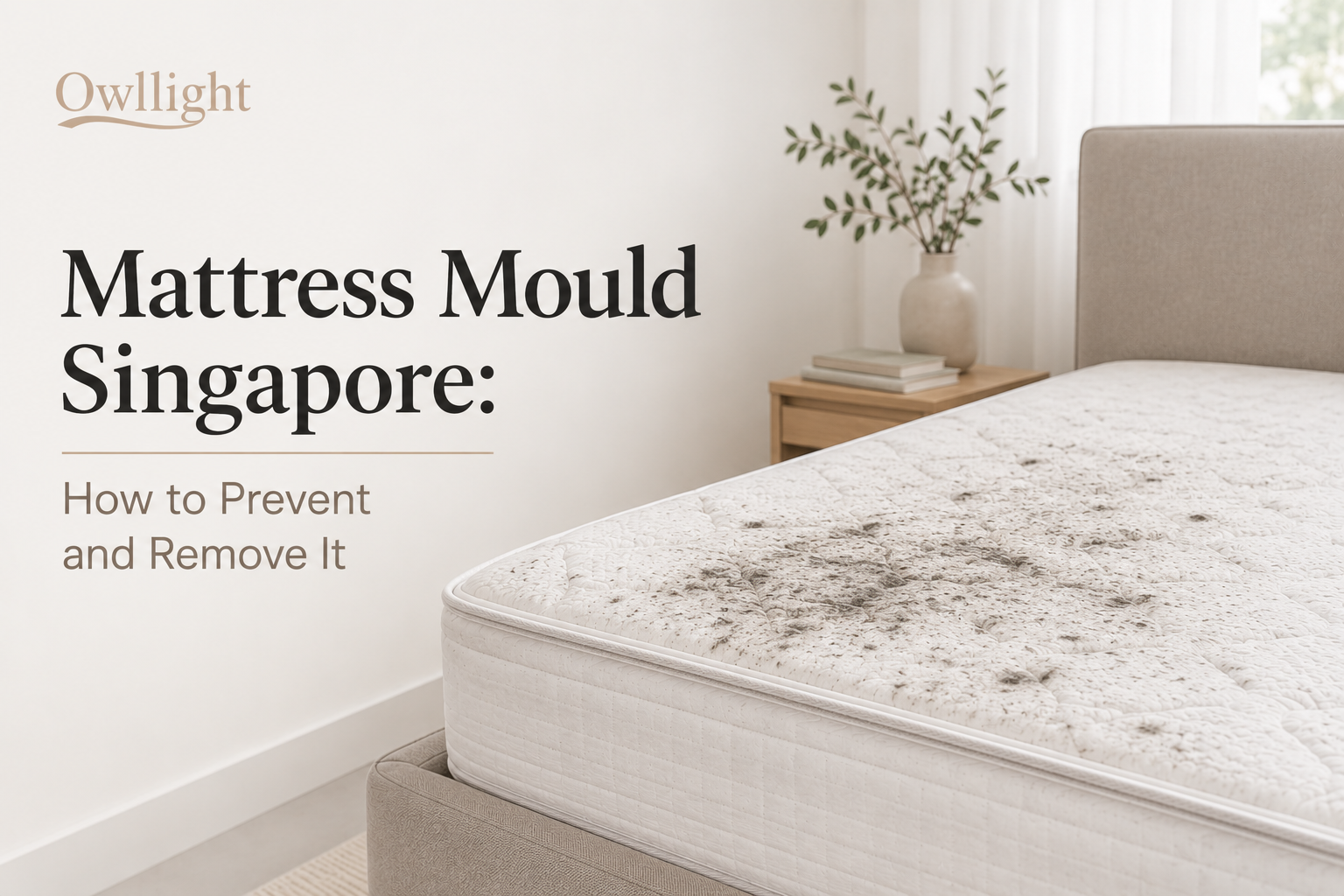
Mattress mould is common in Singapore because the air sits at 70–90% relative humidity most of the year, and mould only needs around 60% to grow. The usual culprits: a mattress flat on the floor, a bed pushed against an external wall, a ground-floor or north-facing room, and trapped sweat. Prevent it with airflow underneath the mattress (a slatted base, not a solid platform), a breathable construction, a washable protector, and a dehumidifier or aircon running below 60% humidity. Light surface mould on a washable layer can often be cleaned. Deep mould inside foam means replace it. If you have breathing symptoms or allergies, see a doctor — don't self-diagnose off a blog.
If you've lifted your mattress and found black or greenish patches underneath, you're not careless and you're not alone. In Singapore's climate, mould is less a hygiene failure and more a physics problem. The conditions mould needs are simply sitting in the air around your bed every night.
The good news is that mattress mould is preventable, and minor cases on the right materials are fixable. The key is understanding why it starts — because the fix follows directly from the cause.

Why Singapore's Climate Causes Mattress Mould
Singapore's relative humidity typically runs between 70% and 90% year-round, easing only briefly during the monsoon shifts (Singapore meteorological norms, 2024). Mould spores are always present in indoor air everywhere — they only need moisture and a surface to grow on. Most common household moulds become active at around 60% relative humidity and above.
That means our ambient air sits above the mould threshold for much of the year, before you've added anything to it. Then you sleep on the mattress.
An adult loses roughly 0.5 to 1 litre of moisture through sweat and breath over a night's sleep (general physiology estimate). A lot of that moves down into the mattress. If it can't escape — because the underside of the mattress has no airflow — it condenses against the cooler base and sits there. Warm, dark, damp, undisturbed: that is the exact recipe for mould.
The high-risk setups
Some beds are far more prone to mould than others. If you recognise yours here, treat prevention as non-optional:
- Mattress directly on the floor. The single biggest cause we see. There's nowhere for underside moisture to go, and the floor stays cooler than the mattress, so moisture condenses against it.
- Bed pushed flush against an external wall. External walls run cooler and can carry condensation, especially in older flats. The mattress edge in contact with the wall stays damp.
- Ground-floor and low-floor units. Closer to ground-level moisture, often less air movement.
- Rooms that get little sun or airflow. A north-facing room, a room kept closed all day, or a room where the aircon never runs all hold humidity longer.
- Solid platform or storage-bed bases. A solid surface under the mattress, or a closed storage box, traps moisture the same way the floor does.
How to Prevent Mattress Mould
Prevention comes down to one principle: keep moisture moving away from the mattress instead of letting it pool. Five things do most of the work.
1. Give the underside airflow
This is the most important fix and the one most people skip. Air needs to circulate under the mattress, not just over it.
- Use a slatted bed base with gaps between the slats, rather than a solid platform or a flat board. The gaps let underside moisture escape.
- If your mattress is on the floor, get it off the floor. A simple slatted frame or even a breathable bed riser changes everything.
- Pull the bed a few centimetres off any external wall so air can move along that edge.
2. Air the mattress out regularly
Once a month, strip the bed and let the mattress breathe. Stand it on its side if you can, or fold back the bedding and open the windows and run a fan across it for a few hours. If your mattress is two-sided, flipping or rotating it on the same schedule also helps moisture release evenly. Morning is best — the air is slightly drier and you're not fighting the afternoon heat.
3. Use a breathable mattress and topper construction
Materials matter more than most people realise. Solid memory foam acts as an insulator and a moisture trap — heat and sweat collect with nowhere to go, which is precisely the damp microclimate mould wants. Open-cell and spring constructions let air and moisture pass through.
This is part of why we built around 4D Air Fiber: it's an open-cell polymer fibre that's roughly 95% air by volume, so moisture moves through it vertically rather than pooling underneath. It's also the rare topper where the entire core is machine washable, not just the cover — which matters a great deal in a climate where the sleeping surface absorbs moisture constantly. A breathable surface won't make a damp, airless room safe on its own, but it removes one of the main moisture traps in the stack.
4. Use a washable mattress protector
A protector intercepts sweat before it reaches the mattress, and it's far easier to wash a protector than to clean a mattress. In Singapore, look for a breathable protector — some waterproof protectors are plastic-backed and trap heat and moisture on top of the mattress, which can make overheating worse. Wash it every two to three weeks. A protector is the cheapest insurance against mould you can buy.
5. Control room humidity with a dehumidifier or aircon
If you can keep the bedroom below 60% relative humidity, you've moved the room under the mould threshold. Two practical ways:
- A dehumidifier running in the bedroom, ideally with a built-in hygrometer so you can target around 55%. A cheap standalone humidity meter (a few dollars) lets you actually see where your room sits rather than guessing.
- Air conditioning, which removes humidity as it cools — most units have a "dry" mode that prioritises this. The catch is the common Singapore habit of running aircon for a few hours then switching to fan or off: the temperature drops but humidity creeps back up overnight, so the dry window is short. A dehumidifier holds the level more consistently than aircon cycling on and off.

How to Clean Light Mould on a Mattress
If you've caught it early — a few small surface spots, a faint musty smell, nothing soaked deep into the foam — you can often deal with it yourself. Work in a ventilated space, ideally outdoors or with windows open and a fan running, and wear a mask so you're not breathing in spores.
- Vacuum the surface first with an upholstery attachment to lift loose spores. Empty the vacuum outside afterwards.
- If the affected layer is washable — a removable cover, or a fully washable core like 4D Air Fiber — wash it per the care label. For air fibre, cool water is recommended to protect the material. This is the cleanest outcome, because you're removing the mould rather than just treating the surface.
- For a non-washable surface, lightly dab the spots with a cloth dampened (not soaked) in a mild solution — diluted white vinegar is a common household choice. Blot, don't scrub mould deeper in. Avoid drenching the mattress, since added moisture is the original problem.
- Dry it completely. This step is non-negotiable. Sun-dry outdoors if you can, or use a fan and the dehumidifier until the area is bone dry. Any residual dampness will bring the mould straight back.
One honest caveat: surface cleaning treats what you can see. Mould on a porous material can have roots below the surface. If the musty smell or the staining returns after cleaning, the mould is established deeper than a wipe-down can reach — and that changes the decision.

When to Replace the Mattress Instead
Cleaning has limits. Replace the mattress rather than fight it when:
- Mould has soaked into solid foam. Memory foam and similar dense foams are porous and can't be washed or fully dried. Visible mould usually means more underneath. This isn't worth saving.
- The patches are large or keep coming back after you've cleaned and fixed the airflow.
- There's a persistent musty smell you can't clear — that's mould you can't see.
- The mattress is already old or sagging. If it's near the end of its life anyway, a mould problem is a reasonable prompt to replace it — and to fix the base and humidity at the same time so the new one doesn't follow it.
If you're at the replacement stage, choosing a breathable construction and pairing it with a slatted base and humidity control is what stops the cycle repeating. Our Tulip mattress pairs a pocket-spring core — which creates vertical airflow through the mattress — with 4D Air Fiber and Tencel cooling layers, a construction designed to move heat and moisture rather than hold them. (For more on knowing when a mattress is genuinely done, see our guide on when to replace your mattress in Singapore.)
The Practical Prevention Checklist
If you take nothing else from this, run through these:
- Get the mattress off the floor and onto a slatted base.
- Pull the bed a few centimetres off any external wall.
- Use a breathable, washable protector and wash it every 2–3 weeks.
- Strip and air the mattress monthly; rotate or flip if it's two-sided.
- Keep the bedroom under 60% humidity with a dehumidifier or aircon dry mode — and measure it.
- Choose a breathable mattress and topper over solid moisture-trapping foam.
Mould in Singapore is a moisture-and-airflow problem at heart. Fix the airflow under the bed, keep the room dry, and the conditions mould needs simply stop being there.
See the 4D Air Light Flow Topper →
Read: choosing a cooling mattress topper in Singapore →
Frequently Asked Questions
Why does my mattress get mouldy in Singapore?
Singapore's relative humidity usually sits between 70% and 90% year-round, and common household moulds start growing at around 60% humidity. On top of that, you lose moisture through sweat and breath every night, much of which moves into the mattress. If the underside has no airflow — for example a mattress on the floor or on a solid base — that moisture pools against the cooler surface and mould grows. It's a moisture-and-airflow problem, not a cleanliness one.
How do I prevent mould on a mattress on the floor?
The most effective step is to get the mattress off the floor and onto a slatted bed base so air can circulate underneath. If that isn't possible immediately, stand the mattress up against a wall to air out daily, keep the room under 60% humidity with a dehumidifier or aircon, use a breathable washable protector, and never leave the mattress flat on the floor undisturbed for long periods. A floor mattress is the highest-risk setup for mould in Singapore's climate.
Can I clean mould off my mattress, or do I need to replace it?
Light surface mould can often be cleaned, especially on a washable layer — vacuum it, wash the cover or washable core per the care label, or lightly treat the spots with diluted white vinegar, then dry it completely. But mould that has soaked into solid foam, large or recurring patches, or a persistent musty smell usually means the mould is established deeper than cleaning can reach. In that case, replacing the mattress and fixing the base and room humidity is the lasting solution.
What humidity level prevents mattress mould?
Keeping your bedroom below 60% relative humidity moves the room under the threshold most household moulds need to grow. Many people aim for around 55% with a dehumidifier, which holds the level more consistently than air conditioning that's switched on for a few hours then off. A cheap humidity meter lets you see your actual room level rather than guessing.
Is mattress mould dangerous to my health?
Mould exposure can aggravate allergies and respiratory irritation in some people, and individual sensitivity varies widely. This article covers how to deal with the mattress itself, not your health. If you or anyone at home has ongoing coughing, wheezing, a blocked nose, or other breathing symptoms, see a doctor rather than relying on general guidance online.