

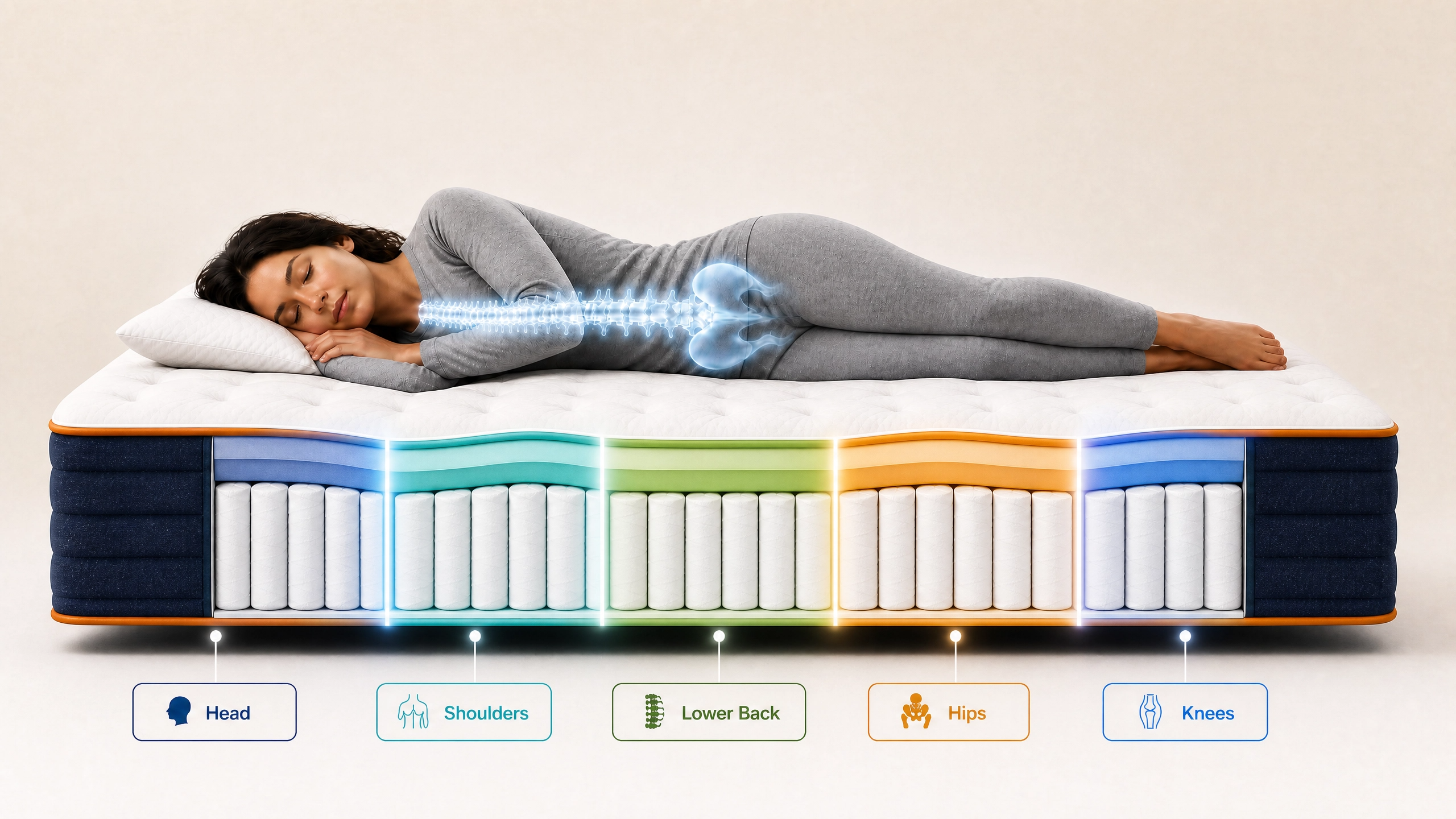
Side sleeping creates pressure at the shoulder and hip — the two points where your body makes contact with the mattress. You need enough give at those points for pressure relief, and enough support beneath them to keep your spine horizontal. The Owllight Tulip Hybrid's 5-zone pocket spring system addresses both: a softer shoulder zone for pressure relief, firmer lumbar and hip zones for spinal alignment. It's the most structurally appropriate option in its price range for side sleepers with back concerns.
Why Side Sleepers Have Different Requirements
When you sleep on your side, your body isn't a flat surface, your shoulder and hip protrude downward while your waist doesn't. If the mattress is too firm, those protrusion points get compressed (pressure points), and your spine bends laterally to compensate. If the mattress is too soft, your hip sinks too far and your spine curves the other way.
The ideal mattress for a side sleeper allows the shoulder and hip to sink just enough to keep the spine horizontal, while providing enough resistance under the waist to prevent the torso from collapsing. This balance is different for every body shape, lighter people generally need a softer surface to achieve that sink, heavier people need more resistance.
Most generic "medium-firm" ratings don't tell you whether the mattress is differentiated by zone. A uniformly medium-firm surface may be fine for back sleepers but problematic for side sleepers if it doesn't have a softer shoulder zone to allow shoulder depression.

What Back Pain Looks Like for Side Sleepers
For side sleepers, back pain typically manifests in two ways. Hip pain at the pressure point means the mattress is too firm, the hip is compressing against a surface that won't accommodate it. Lower back pain that's worse on one side usually means the spine is being bent laterally due to insufficient support under the waist, or too much sink at the hip.
Shoulder pain is also common for side sleepers, either from shoulder compression on a too-firm mattress, or from the shoulder being in an awkward position because the mattress surface isn't supporting the rest of the body at the right height. The mattress and pillow height interact here; if the mattress is right but the pillow is too flat or too high, you'll still get shoulder and neck tension.
Why a Zoned Pocket Spring Suits Side Sleepers
A 5-zone pocket spring system maps different tension levels to different body zones. In the Owllight Tulip Hybrid, the shoulder zone is calibrated to allow more compression than the lumbar and hip zones. This is the structural solution to the side sleeper problem: the shoulder sinks appropriately while the waist and lower back get firmer resistance.
A uniform coil tension system — standard in most mattresses under $800 doesn't offer this. The shoulder and lumbar regions get the same resistance, which means you're compromising somewhere. Either the shoulder is supported correctly and the lumbar zone is too soft, or the lumbar zone is supported correctly and the shoulder is under too much pressure.
This is the reason physiotherapists often recommend zoned mattresses for patients with lateral back pain or shoulder issues. The zoning does measurable work that a uniform surface can't.
Mattress Firmness — What Side Sleepers Should Look For
Side sleepers generally do best on medium to medium-firm mattresses. Very firm mattresses create too much shoulder and hip pressure. Very soft mattresses allow excessive hip sink that laterally curves the spine.
The complication is body weight. A 55kg person and a 90kg person will experience very different compression on the same mattress surface. If you're lighter, you may need a softer mattress to achieve sufficient shoulder and hip depression. If you're heavier, a medium-firm construction will compress more under your weight than it would for a lighter person.
This is why testing a mattress or having a trial period matters and firmness ratings describe the starting tension, not how the mattress responds to your specific body weight and pressure distribution.

Cooling — An Extra Consideration for Side Sleepers in Singapore
Side sleepers have less body surface in contact with the mattress than back sleepers do, which means airflow is slightly less of an issue. However, Singapore's humidity means that even side sleepers can wake up warm, particularly at the shoulder and hip contact points.
The Tulip Hybrid's pocket spring core allows heat to dissipate through the coil system. If you're a particularly warm sleeper, Owllight's 4D Air Light Flow Topper is a practical addition — the 3D Air Fiber fill creates a breathable surface layer that doesn't trap heat at the contact points.
Pillow Height for Side Sleepers
The mattress is only part of the equation. Side sleepers also need a pillow that fills the gap between the ear and the shoulder typically a medium-to-high loft pillow. If the pillow is too flat, the neck tilts downward and creates tension that presents as shoulder or upper back pain the next morning.
Owllight's Butterfly Edition neck pain pillow is designed for this. The contoured shape positions the neck and head correctly for both side and back sleepers. A good mattress with a mismatched pillow won't solve neck and shoulder issues; the two need to work together.
Frequently Asked Questions
Should side sleepers use a firm or soft mattress?
Medium is the practical target for most side sleepers, but the more important factor is zoning. A zoned medium-firm mattress (softer at the shoulder, firmer at the lumbar and hip) performs better for side sleepers than either a uniform firm or uniform soft surface.
Can side sleeping cause back pain?
Side sleeping itself is generally considered a healthy sleep position. Back pain from side sleeping is almost always caused by a mismatch between the mattress surface and body requirements — either too much or too little compression at the shoulder and hip, leading to lateral spinal bending.
Is the Owllight Tulip Hybrid suitable for side and back sleepers?
Yes. The 5-zone pocket spring design supports both sleeping positions — the shoulder zone compression suits side sleeping, while the firmer lumbar zone suits back sleeping. Combination sleepers (people who shift positions during the night) typically do well on this construction.
Does mattress firmness affect side sleeper shoulder pain?
Directly. A mattress that's too firm for your body weight won't allow the shoulder to compress enough, creating lateral pressure at the rotator cuff and surrounding muscles. This presents as shoulder soreness or numbness in the morning. Switching to a mattress with a softer shoulder zone (or a softer overall firmness) typically resolves this within 2–3 weeks.
If you sleep on your side and you're consistently waking up with stiffness or shoulder tension, it's worth testing the Tulip Hybrid — see the current price and sizing options here, or visit the Owllight showroom to try the mattress in your actual sleeping position before you buy.