.png?w=615&h=171)
-(Large).png?w=1920&h=1080)
Why Your Back Hurts Every Morning (And What Your Mattress Has to Do With It)
Morning back pain that eases within 30 minutes of getting up is almost always a sleep surface problem — your mattress is not supporting your spine correctly through the night. The five most common causes: wrong firmness for your position, a sagging mattress, poor sleep posture, air-conditioning stiffness, and desk work compounding overnight. Here's how to tell which one is yours — and what to do about it.
You wake up. Your lower back is stiff, tight, or aching. You get up, move around, make coffee — and 20 to 30 minutes later, it's mostly gone. By the time you're at your desk, you've almost forgotten it.
Until tomorrow morning, when it happens again.
This specific pattern — back pain worst at waking, improving with movement — is one of the clearest diagnostic signals in sleep medicine. It tells you the problem is positional and nocturnal, not structural. Which is actually good news: it means something fixable is happening while you sleep, not something wrong with your spine that requires medical intervention.
The most common cause, by a significant margin, is your mattress.
5 Reasons Your Back Hurts Every Morning

1. Your Mattress Firmness Doesn't Match Your Sleep Position
This is the leading cause of morning back pain in Singapore, and it's the most fixable.
Every sleep position requires a different firmness to keep your spine neutral through the night. Side sleepers need the hip and shoulder to sink enough for the spine to stay straight — a mattress that's too firm creates a lateral arch at the lower back. Back sleepers need the lumbar to maintain contact with the mattress — one that's too soft lets the lower back sag into a hammock curve. Stomach sleepers (already hard on the back) need firmness under the hips to prevent the pelvis from tipping forward.
The mismatch doesn't hurt while you're falling asleep. It accumulates over 6–8 hours of static pressure on misaligned spinal tissue. By morning, the muscles and ligaments that spent the night compensating are the ones telling you about it.
How to test this: Try sleeping on a different surface for a week — a hotel bed, a guest room mattress, a mattress at a showroom you visited. If your morning pain decreases or disappears, firmness mismatch is the issue.
2. Your Mattress Has Lost Its Support
Mattresses degrade. Pocket springs lose tension. Foam develops permanent body impressions. The support you felt when you bought the mattress 7 years ago is not the support you're sleeping on now.
This happens gradually enough that you don't notice the change — just a slow worsening of morning stiffness over months. You adapt your sleep position slightly. Then you adapt again. By the time the pain is consistent every morning, the mattress has been inadequate for a long time.
In Singapore's humidity, mattress degradation happens faster. Moisture cycles weaken foam cell structure and accelerate spring fatigue. A mattress that would last 10 years in a dry European climate may need replacement in 7–8 years here.
How to test this: Check for visible sagging or body impressions — even 2–3cm of sag significantly disrupts spinal alignment. Run your hand along the surface while it's unloaded. Any permanent indentations mean the support structure is compromised.
3. Your Sleep Position Is Straining the Lumbar
Even on the right mattress, some sleep positions create lumbar stress.
Side sleeping with knees together and stacked rotates the pelvis slightly, pulling on the lower back through the night. The fix is a pillow between the knees — it takes three minutes and works immediately for many people. Back sleeping with legs flat can flatten the natural lumbar curve; a pillow under the knees restores it. These are adjustments you can make tonight at no cost.
Stomach sleeping is genuinely hard on the back regardless of mattress choice. The neck is rotated to breathe, the lumbar is arched forward, and there's no position where the spine is fully neutral. If you're a committed stomach sleeper with morning back pain, the most effective single change is to work on shifting to side or back sleeping — even if it takes a few weeks to adjust.
4. Air-Conditioning Through the Night
This one is specific to Singapore and often overlooked.
Sleeping in a cold, air-conditioned room (below 22°C) causes muscle cooling and mild contraction throughout the night. For people with existing lower back tension — which most desk workers in Singapore have — this overnight muscle cooling means waking up with noticeably more stiffness than on nights without air conditioning, or on warmer nights.
This isn't the primary cause of structural back pain, but it amplifies it. If your mattress is already providing suboptimal support, the muscle stiffness from a cold room makes the morning worse than it would otherwise be.
How to test this: Sleep one week without air conditioning (or at 25–26°C instead of 20°C) and compare morning stiffness. A significant improvement points to temperature as a contributing factor.
5. Desk Posture Accumulating Overnight
Singapore's WFH culture — and long desk hours generally — means many people arrive at their mattress already carrying 8–10 hours of accumulated spinal compression. The hip flexors are shortened from sitting. The thoracic spine is rounded. The lumbar erectors are fatigued.
A good mattress gives these structures the overnight decompression they need. A poor mattress means they don't recover — they stay loaded through the night and are still loaded when you wake up. The morning pain is the debt that accumulated from the day plus an ineffective night of recovery.
This is why the same mattress that worked fine in your 20s stops working in your 30s when desk hours increase. The mattress hasn't changed — your recovery need has.
How to Tell If Your Mattress Is the Cause

Three diagnostic tests you can do at home:
- The morning timing test: Does the pain ease within 20–30 minutes of getting up and moving? If yes, it's sleep-surface related. Pain that persists through the day or worsens with movement points to a structural issue worth seeing a physiotherapist about.
- The travel test: Does your back feel better after a few nights away from home — in a hotel, at a family member's place? If consistently yes, your home mattress is the variable.
- The visual inspection: Unload your mattress and check the surface in raking light. Any visible sagging, body impressions, or uneven surfaces mean the support structure is compromised regardless of how it feels when you're lying on it.
What to Look for in a Back-Care Mattress
If your mattress is the issue, here's what to look for in a replacement:
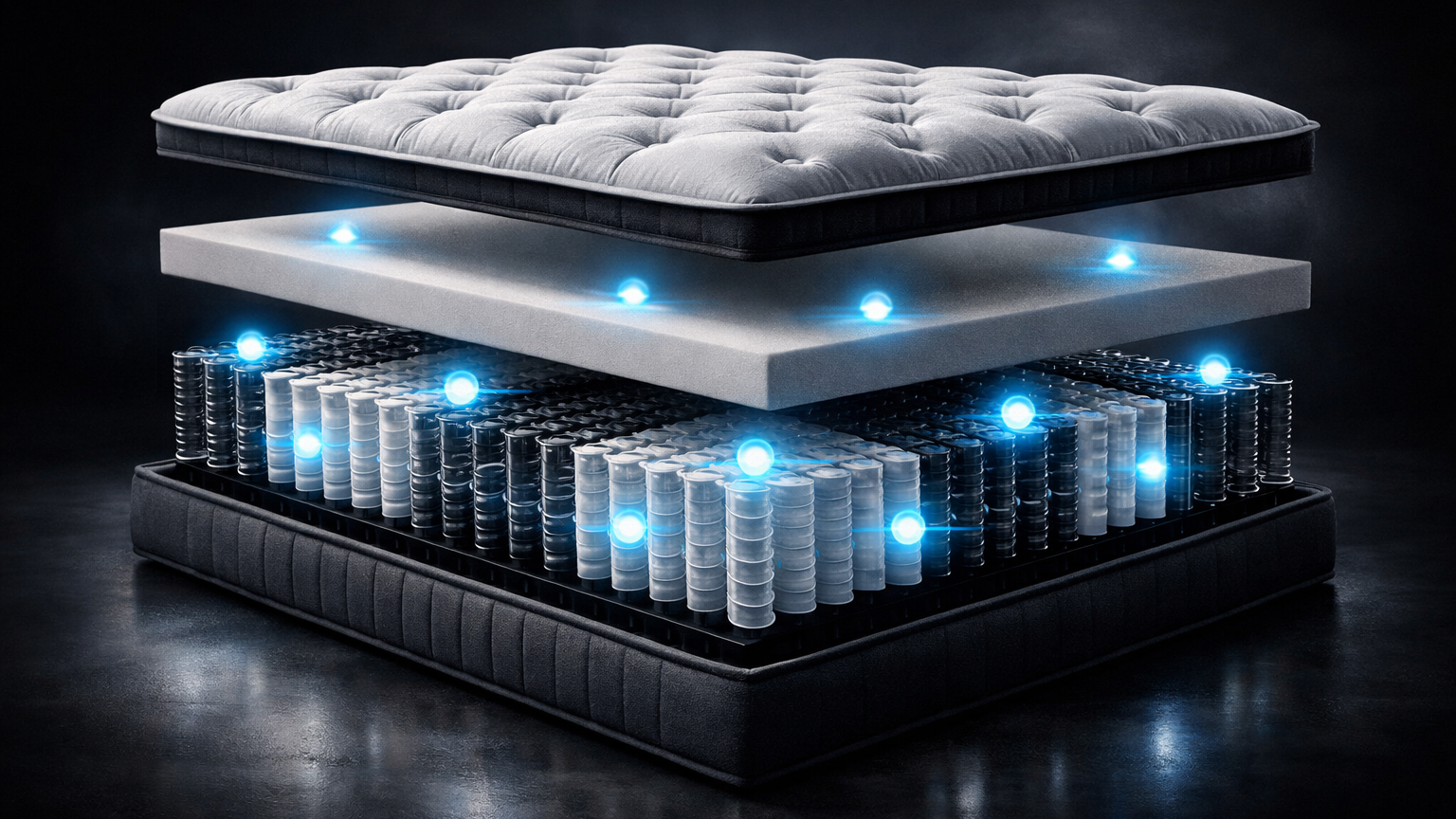
Zoned support, not uniform firmness. Different parts of your spine need different support levels. A 5-zone pocket spring system — where spring tension varies by body region — maintains spinal alignment far more effectively than a uniform foam surface.
Pocket springs over foam-only. Individual pocket springs respond to each part of the body independently. They don't transfer motion, they don't degrade in body impressions the way foam does, and they allow airflow through the mattress — relevant for Singapore's humidity.
CertiPUR-US certified foam. The comfort layers around the spring system should use tested, certified foam — particularly if you spend 7–8 hours breathing the air near your mattress surface every night.
A real trial period. Morning back pain is the test. You need at least 30 nights on a new mattress to know if it's working — your body adapts to new sleep surfaces, and the first week is not representative. A 100-night trial gives you enough time to know for certain.
See if the Tulip Hybrid is right for your back — specs and current pricing →
Frequently Asked Questions
Why does my lower back hurt when I wake up but feel better during the day?
Morning back pain that improves within 20–30 minutes of getting up is typically caused by sleep surface issues — your mattress is not supporting your spine in a neutral position through the night. The static pressure of sleeping on a misaligned surface accumulates over 6–8 hours. Movement during the day pumps fluid back into spinal discs and relieves the muscle tension caused overnight, which is why the pain eases with activity.
Can my mattress cause lower back pain?
Yes. A mattress that is too firm, too soft, sagging, or has body impressions can place the spine in a misaligned position for hours each night. Over time this causes morning stiffness, lower back muscle fatigue, and chronic pain patterns. If your pain is worst at waking and eases with movement, your mattress is likely a contributing cause.
How do I know if I need a new mattress for back pain?
Signs your mattress needs replacing: visible sagging or body impressions of 2cm or more; morning back pain that has gradually worsened over 1–2 years on the same mattress; sleeping better consistently when away from home; a mattress that is 8+ years old. In Singapore's humidity, mattresses degrade faster than in drier climates — a 7–8 year old mattress in Singapore may perform like a 10 year old mattress elsewhere.