.png?w=615&h=171)

Best Pillow for Neck Pain Singapore: Why Shape Matters More Than Softness
Neck pain after sleep is almost always a cervical alignment problem — not a softness problem. A pillow that feels plush may still leave your head tilted forward or sideways for 7–8 hours, and that sustained misalignment is what causes the stiffness you wake up with. The fix isn't a softer pillow. It's a pillow shaped to hold your head and neck in a neutral position through the night — which is exactly what a butterfly-contour cervical pillow is designed to do.
Why Your Neck Hurts in the Morning
If you wake up with a stiff neck, a dull ache at the base of your skull, or tension that radiates into your shoulders — your pillow is almost certainly involved.
Here's the mechanics of it. Your cervical spine has a natural inward curve (the cervical lordosis). When you're upright, your head sits balanced over your spine with minimal effort. When you lie down, that balance depends entirely on what your head is resting on. If your pillow doesn't maintain that curve — if your head drops too low, tilts too far forward, or rotates sideways — your neck muscles have to compensate. For 7–8 hours.
That sustained low-grade strain is what you feel when you wake up. It's not dramatic. It's not an injury. It's just tissue that's been working when it should have been resting. Night after night, it compounds.
For Singaporeans spending long hours at a desk, hunching over a laptop from home, or riding long commutes — the neck is already carrying more load during the day. A pillow that doesn't decompress it properly during sleep means you're starting every morning at a deficit.
 Why "Just Get a Softer Pillow" Doesn't Fix Neck Pain
Softness is comfort. Alignment is function. They're not the same thing.
A very soft pillow compresses under the weight of your head and stops providing meaningful support. Your head sinks through it. The gap between your neck and the mattress is left unfilled. The cervical curve collapses. You feel comfortable for the first 20 minutes, and then your muscles quietly start compensating.
A very firm pillow holds its shape — but height matters just as much as firmness. If it's too high, it pushes your head forward. If it's the wrong shape, it leaves gaps at the sides where your neck loses contact with the pillow. Firmness alone doesn't solve the problem.
What actually matters is that the pillow fills the right spaces, at the right height, for your specific sleeping position. That's a geometry problem — not a material problem.
What Actually Matters in a Neck Pain Pillow
There are four things worth paying attention to:
Loft (height)
Loft is the pillow's height when compressed under the weight of your head. For side sleepers, the right loft equals roughly the distance from your ear to the tip of your shoulder — this keeps your spine level. For back sleepers, you want lower loft — enough to fill the gap at the back of your neck, but not so much that your head is pushed forward.
Shape
This is the most underrated factor. A rectangular pillow treats every sleeper the same. Contoured designs — especially butterfly or cervical-curved profiles — are shaped to actively support the neck rather than just sit under it. The shape guides your head into the right position rather than requiring you to find that position yourself.
Material and response
Memory foam and latex respond differently. Memory foam conforms slowly to your shape and holds it — good for reducing pressure points. Latex springs back — more responsive, slightly cooler. In Singapore's climate, ventilation matters: dense foam that traps heat will wake you up. Look for open-cell memory foam or materials with active airflow.
Position compatibility
Your pillow needs to work for how you actually sleep — not how you start the night. Side sleepers and back sleepers have different loft and shape requirements. A good neck pain pillow should address both, because most people shift positions during the night.
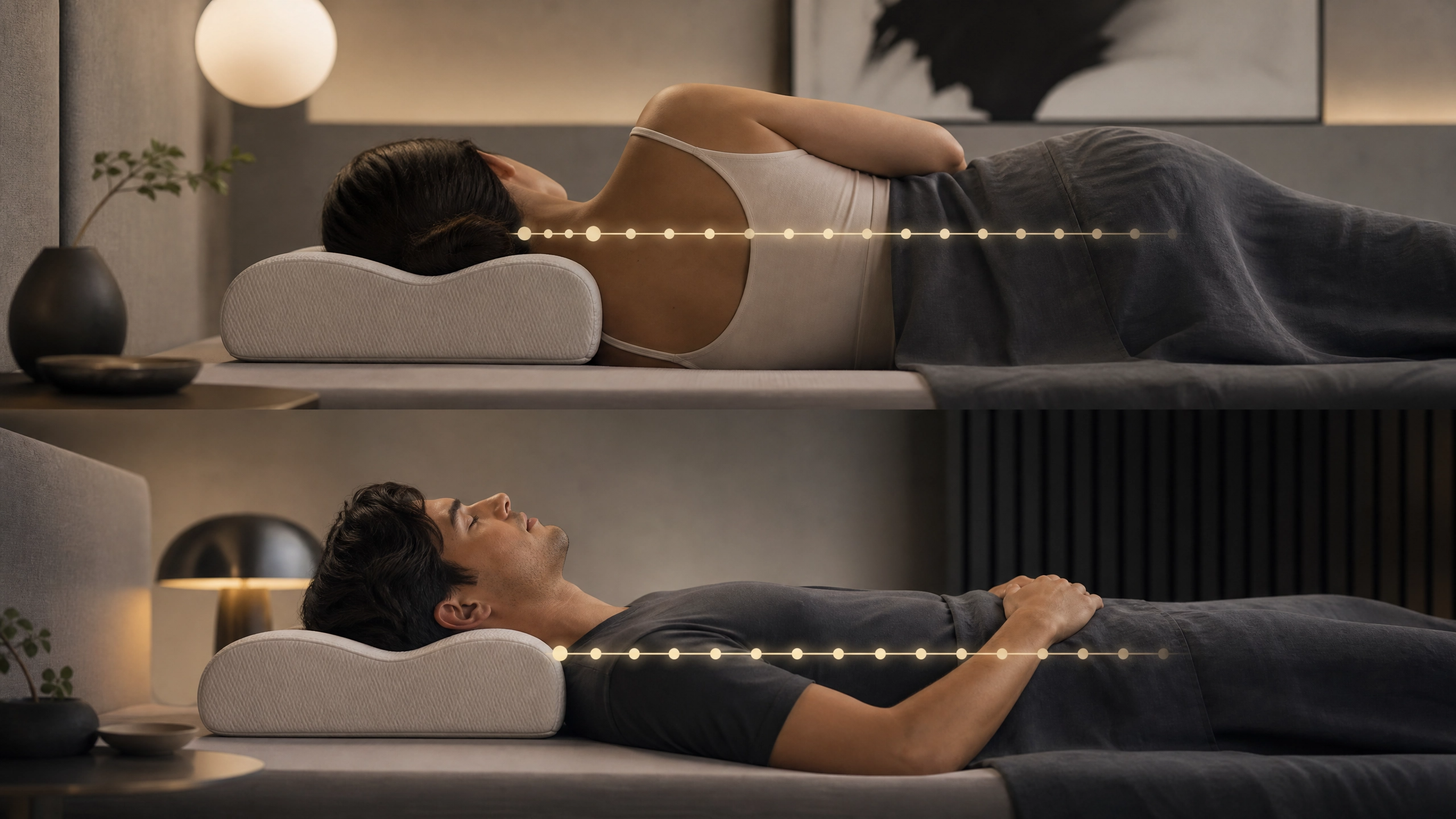 Side Sleepers vs Back Sleepers: Different Needs
These two positions create completely different geometry for the neck, and it's worth being specific.
| Sleep position | Neck gap to fill | Ideal loft | Key risk with wrong pillow |
|---|---|---|---|
| Side sleeper | Shoulder-to-ear distance | Higher — 10–14cm depending on shoulder width | Head drops toward mattress, lateral neck strain |
| Back sleeper | Neck curve behind the cervical spine | Lower — 7–10cm | Head pushed forward, chin-to-chest strain |
| Combination sleeper | Both gaps depending on position | Medium with contouring for transitions | Neither position supported well; waking with stiffness |
Most people are combination sleepers. They start on their back, shift to their side, maybe roll partway through the night. A pillow that only works in one position will fail them for part of every night.
What Is a Butterfly-Contour Pillow and Why Does It Work
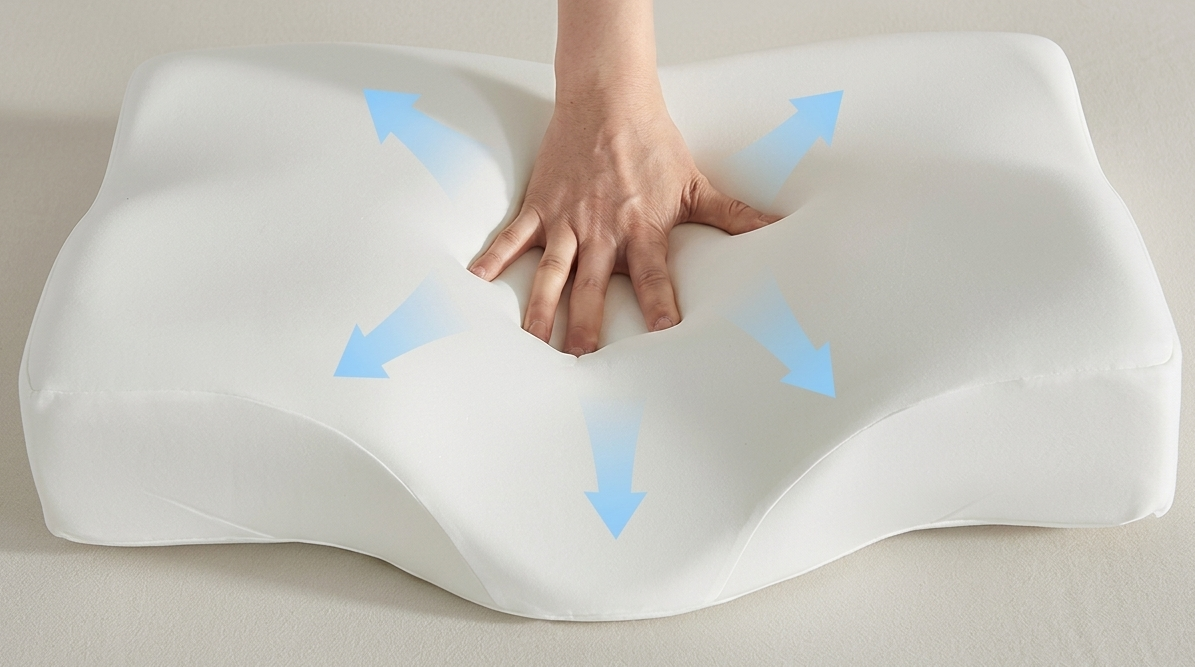
A butterfly pillow is a cervical pillow with a specific shape: a lower central cradle for the head, flanked by two higher arched "wings" that support the neck and shoulders on either side.
The name comes from the silhouette when you look at it from above — it resembles a butterfly with a recessed body and raised wings. That geometry is functional, not decorative.
Here's what the shape actually does:
- The central cradle holds the back of your head at a lower height, preventing it from tilting too far forward or backward. Your head sits in a neutral position rather than resting on a flat surface that offers no guidance.
- The wing arches rise on either side to fill the neck gap. Whether you sleep on your back or shift to your side, the wings support the cervical curve continuously — you don't fall off the "supported zone."
- The shoulder cutouts on a well-designed butterfly pillow allow your shoulders to sit naturally rather than being pushed upward. This is the part that rectangular pillows miss entirely — they stack the shoulder on top of the pillow edge, which tilts the whole cervical spine.
The result is that the pillow holds your head from tilting in any direction. Your neck muscles can fully relax. That's the function a standard pillow, regardless of softness or fill, cannot replicate by shape alone.
The Owllight Butterfly Pillow uses this exact ergonomic contour design — shaped specifically for the Singapore neck pain sufferers who need consistent cervical support across back and side sleeping positions. The memory foam core conforms to your cervical curve, and the butterfly shape prevents the head from drifting forward or sideways overnight.
 What to Look for When Buying a Neck Pain Pillow
Loft guide by shoulder width
A rough guide for side sleepers: measure the distance from your neck to the edge of your shoulder. Most Singaporean adults fall in the 10–13cm range. Back sleepers need less — typically 7–10cm. If a pillow doesn't specify loft clearly, ask. A pillow labelled only as "medium" tells you nothing useful.
Material in Singapore's climate
Dense memory foam without ventilation will absorb heat. In an HDB room where air-con runs intermittently — or not at all through the night — this matters. Look for open-cell memory foam, ventilated foam cores, or latex (which runs naturally cooler). Washable pillowcases are also worth prioritising: humidity means higher moisture accumulation over time.
Washability
Singapore's humidity is a real consideration for pillow hygiene. A pillow you can't wash will collect moisture, dust mites, and bacteria faster than in drier climates. A removable, machine-washable cover is a minimum standard. Some cervical pillows also have washable inner liners — worth checking before you buy.
What to ignore
Marketing claims about "advanced cervical technology" or "medical-grade support" without specification behind them. What matters is the actual loft, the verified shape, and the material properties. If those aren't stated clearly, the claim is padding.
Singapore office workers, take note: If you're spending 8+ hours at a desk in an air-conditioned office and another 1–2 hours commuting in a cold train — your neck is dealing with sustained low temperature and postural load every day. A cervical pillow that decompresses properly overnight is not a luxury. It's the simplest way to break the cycle.
The Mattress-Pillow Combination: Why Both Matter
A cervical pillow does a specific job: it supports the neck. But it can only do that job well if the mattress underneath is also doing its job.
Here's the connection that most people miss. When a mattress is too soft under the shoulders, your shoulder sinks deeper into the mattress than your hips. This creates a slight lateral tilt to the whole upper spine. That tilt pushes the neck out of alignment regardless of what your pillow is doing. You can have the best-shaped cervical pillow in the world, and a poor mattress will undermine it.
The fix is a mattress with differentiated support zones — firmer support under the hips and shoulders, with appropriate give at the lumbar. A 5-zone pocket spring system does this: each spring moves independently, so the mattress responds to the weight and shape of your body rather than treating it as uniform pressure.
Owllight's Tulip Hybrid Mattress uses exactly this design. The pocket spring base provides targeted support at the pressure zones — including under the shoulders — while the memory foam comfort layer reduces contact pressure. When paired with the Butterfly Pillow, the whole sleep system works together: the mattress keeps your torso level, the pillow keeps your neck neutral.
If you're getting the pillow right but your mattress is letting the shoulders sink — you'll still wake up with neck strain. The two are connected.
Frequently Asked Questions
The Owllight Butterfly Pillow
Ergonomic butterfly-contour design for side and back sleepers. Shaped to keep the cervical spine neutral through the night — not just during the first hour.
Shop the Butterfly Pillow See the Tulip Hybrid Mattress
The pillow built around the cervical-alignment criteria covered in this guide is the Owllight Butterfly Contour Pillow.
If your pillow choice is right but morning neck pain persists, the mattress shoulder zone may be too firm — see the Tulip Hybrid's zoned support.