.png?w=615&h=171)

Best Mattress for Back Pain Singapore 2026: Chiropractor-Approved Picks
Disclosure: This guide is published by Owllight, a Singapore mattress brand built by a founder with chronic back pain. Owllight products are included in this comparison. All competitor specifications are verified against public data at the time of publication.
A 2024 study by Singapore General Hospital found that 73.4% of office workers in Singapore report musculoskeletal pain with 42% specifically identifying lower back pain as their primary complaint. That's not a wellness statistic. It's a sleep surface problem hiding in plain sight.
Most Singapore mattress brands advertise "orthopedic" support without defining what that actually means clinically. No regulatory body in Singapore certifies mattresses as orthopedic. Any brand can print the word on a label.
This guide applies the criteria from peer-reviewed research, not marketing to evaluate 6 Singapore mattresses for genuine back pain relief. We'll show you exactly what to look for, and which mattress earns the top spot.
TL;DR: A 2021 systematic review (J. Orthopaedics & Traumatology, PMC/PubMed) found medium-firm pocket spring mattresses with zoned support reduce chronic back pain by 55%. For Singapore buyers, the Owllight Tulip Hybrid ($899 queen) delivers all four clinical back care criteria — 5-zone support, pocket springs, CertiPUR-US, 100-night trial — at the strongest value under $1,000.
Can a Mattress Actually Relieve Back Pain?
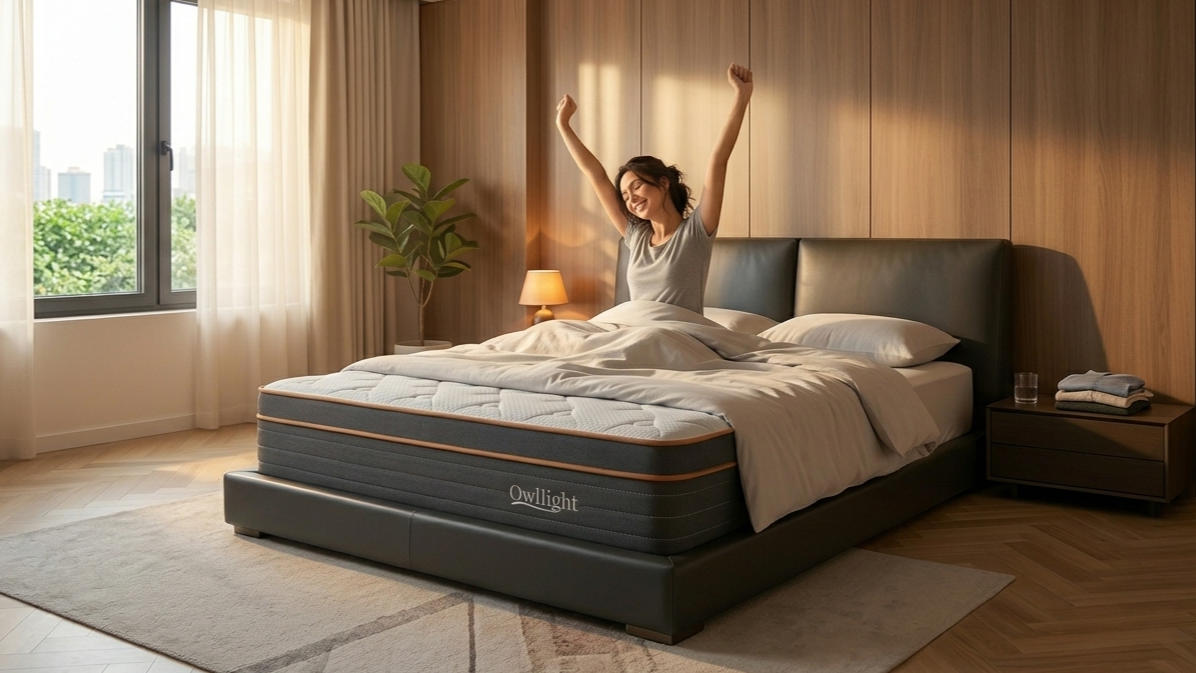
Yes, and the evidence is more specific than most people realise. A 2021 systematic review published in the Journal of Orthopaedics and Traumatology (PMC/PubMed) followed patients with chronic back pain who changed their sleep surface. Those who switched to medium-firm mattresses with pocket spring zoned support saw a 55% reduction in back pain. Not just a comfort improvement, a measurable clinical reduction.
The mechanism makes sense. During sleep, your spine decompresses. Intervertebral discs rehydrate. Paraspinal muscles release tension accumulated during waking hours. But this recovery process only works if your spine maintains neutral alignment throughout the night. A mattress that's too soft lets your hips sink, creating lumbar flexion. One that's too firm creates pressure points at the hips and shoulders, forcing compensatory muscle tension.
The right mattress doesn't just feel comfortable, it enables spinal recovery that the rest of your day prevents.
Chronic back pain affects 73.4% of Singapore office workers (SGH via HealthXchange, 2024), yet the clinical evidence for sleep surface intervention is rarely presented to consumers. A 2021 systematic review in the Journal of Orthopaedics and Traumatology found that medium-firm mattresses with zoned pocket spring support produced a 55% reduction in chronic back pain — a statistically significant outcome that no mattress marketing in Singapore currently references (PMC/PubMed, 2021).
What Features Actually Matter for Back Pain Relief?
Four construction features determine whether a mattress helps or worsens back pain. The word "orthopedic" tells you nothing. These four criteria tell you everything:
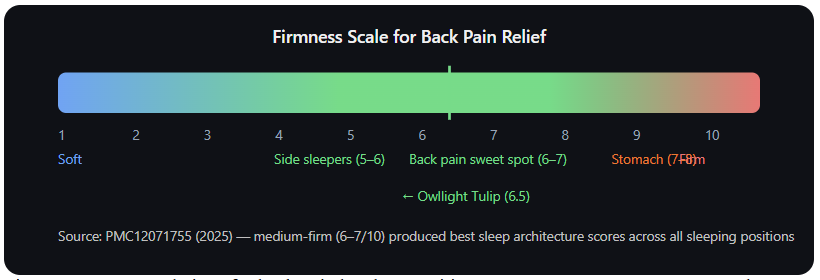
The 4 Clinical Back Care Criteria
1. Medium-firm firmness (6–7/10). This range maintains spinal neutrality — hips and shoulders aligned, lumbar neither overextended nor flexed. A 2025 study (PMC12071755) confirmed medium-firm produced the best sleep architecture scores across all sleeping positions. Too firm creates pressure points that force compensatory muscle tension. Too soft allows hip sinking that flexes the lumbar spine all night.
2. Support zones (5 or more). Your body applies different pressure loads at different contact points. Lumbar needs firmer resistance. Shoulders need give. A mattress with one uniform firmness can't accommodate this. Five zones is the minimum for meaningful zone-specific lumbar calibration.
3. Pocket spring construction. Each pocket spring moves independently, responding only to the pressure applied at that exact point. Foam and latex contour uniformly — they adapt to your body shape but can't provide differential resistance zone by zone. For back pain, this is not a minor distinction.
4. CertiPUR-US certification. Not a back care criterion directly — but you're in contact with these foam layers for 8 hours every night. Independent certification that tests for VOCs, heavy metals, formaldehyde, and ozone-depleting compounds is a minimum standard for responsible mattress selection.
The "orthopedic" problem: No Singapore government body or international sleep medicine body certifies mattresses as orthopedic. It's an entirely unregulated marketing term. Any brand can print it on packaging. Instead of looking for "orthopedic," check for: zone count, spring type (pocket springs vs. continuous coil vs. foam), and third-party certifications like CertiPUR-US. These are the actual indicators — not the label.
The 6 Best Mattresses for Back Pain in Singapore 2026
These six mattresses were evaluated against the four clinical criteria above. They're ranked by back care performance — not price, brand prestige, or advertising spend.
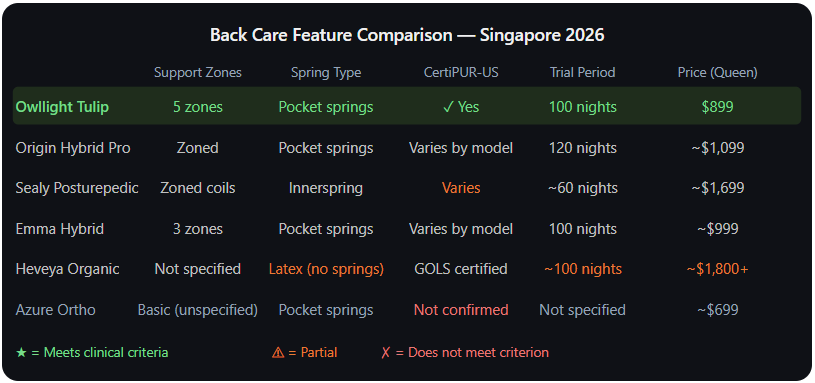
1. Owllight Tulip Hybrid — $899 (Queen)
Best for: Back pain sufferers who want the strongest clinical support credentials under $1,000.
Owllight was founded specifically because of chronic back pain. The Tulip Hybrid is the result of building a mattress to clinical back care specifications — 5-Zone Pro-S Spine Support, 1,500+ independent pocket springs, 4D Air Fiber cooling, and CertiPUR-US certification — rather than working backwards from a margin target. The Lazada #1 mattress topper brand in Singapore reinforces that the clinical positioning connects with actual back pain sufferers. 5-zone spinal support mattress
- Pros: Meets all 4 clinical back care criteria; CertiPUR-US; 100-night trial; Lazada #1 topper brand; $899
- Cons: Newer brand vs. Sealy/Simmons heritage; limited physical showroom access
Verdict: The clinical back care leader under $1,000 in Singapore. No other mattress at this price meets all four criteria.
2. Origin Hybrid Pro — ~$1,099 (Queen)
Best for: Buyers who want established brand trust with a long trial period.
Origin's zoned pocket spring system provides good lumbar support. The 120-night trial is the longest on this list — genuinely valuable for back pain assessment. At $1,099, it's $200 more than Owllight for similar construction without the explicit 5-zone clinical specification.
- Pros: 120-night trial; zoned springs; trusted Singapore brand
- Cons: More expensive than Owllight; CertiPUR-US varies by model; zone count less specific
Verdict: Strong second choice. The 120-night trial is a genuine advantage for cautious buyers.
3. Sealy Posturepedic — ~$1,699 (Queen)
Best for: Buyers who trust century-old brand heritage for clinical back care positioning.
Sealy has built decades of "posturepedic" positioning. Their zoned coil system is genuinely effective for back support. At $1,699, however, you're paying significantly more than Owllight for comparable construction quality — and the "posturepedic" term, like "orthopedic," is a brand trademark, not a clinical certification.
- Pros: Established back care brand; zoned coil system; available in physical stores
- Cons: $800 more than Owllight; shorter trial; no independent foam certification confirmed
Verdict: Quality product, significant brand premium.
4. Emma Hybrid — ~$999 (Queen)
Best for: Side sleepers prioritising pressure relief over specific lumbar zoning.
Emma's Airgocell foam + pocket spring hybrid delivers excellent pressure relief and motion isolation. Award-winning design. The 3-zone system is less specific for lumbar calibration than Owllight's 5-zone. Better for shoulder and hip pain (side sleepers) than pure lower back pain.
- Pros: Multiple international awards; good pressure relief; 100-night trial
- Cons: 3-zone support less specific than Owllight's 5-zone; slightly softer feel
Verdict: Excellent for side sleepers. Owllight remains stronger for lumbar back pain.
5. Heveya Organic — ~$1,800+ (Queen)
Best for: Natural material purists who want GOLS-certified organic latex.
Heveya's natural latex provides excellent pressure relief and is GOLS-certified organic. However, it lacks pocket spring zone mechanics, runs warm in Singapore's humidity, and costs significantly more than Owllight for comparable back support outcomes. Premium for buyers who specifically want organic natural latex.
- Pros: GOLS organic certification; excellent pressure relief; natural materials
- Cons: No pocket springs (latex-only); runs warm in Singapore; expensive
Verdict: For natural material preference only. Owllight leads on clinical back care.
6. Azure Ortho — ~$699 (Queen)
Best for: Budget buyers with mild back discomfort, not chronic back pain.
Azure's "Ortho" branding is unsubstantiated marketing. The pocket spring construction is basic, zone support is minimal, and no foam certification is publicly confirmed. Adequate for occasional use or mild discomfort — not a clinical back care solution.
- Pros: Budget-friendly; basic pocket spring construction
- Cons: "Ortho" claim is marketing; limited zoning; no certified foam safety
Verdict: Emergency budget option only.
Pocket Springs vs. Memory Foam — Which Is Better for Back Pain?
Pocket springs outperform memory foam for back pain support — especially in Singapore's climate. This isn't a subjective comfort preference. It's a mechanical one.
Each pocket spring moves independently. When your lumbar presses down, the springs in that zone compress to the appropriate depth and push back with calibrated resistance. Springs in your shoulder zone respond differently to shoulder pressure. Zone-specific response is physically built into the mechanism.
Memory foam contours uniformly. It responds to heat and pressure by conforming to your body shape — which provides excellent pressure relief but uniform support. It can't vary its response zone by zone because there's no zone mechanism. The foam in your lumbar region behaves identically to the foam under your shoulder.
For side sleepers with shoulder or hip pressure pain, memory foam's uniform contouring is actually ideal. But for lower back pain — where lumbar-specific support is the clinical requirement — pocket springs with 5 zones outperform.
Singapore's 84% average annual humidity (Meteorological Service Singapore, 2025) creates an additional problem for memory foam: foam degradation accelerates in humid conditions. Dense memory foam retains body heat and moisture, and repeated compression in a tropical environment reduces foam resilience faster than in temperate climates. Pocket spring construction with breathable comfort layers — like Owllight's 4D Air Fiber — avoids this degradation pathway entirely. 5-zone pocket spring mattress for back pain
How Long Does It Take for a New Mattress to Help With Back Pain?
Most people notice meaningful improvement within 3–6 weeks of switching to an appropriate support surface. Full adaptation — where your muscles, ligaments, and spinal discs have completely adjusted to the new support profile — takes 60–90 nights.
The first 1–2 weeks can feel uncomfortable. Your body has adapted to the support profile of your old mattress, even if that profile was inadequate. The adjustment period is real and normal.
What to track during your trial:
- Morning back pain on a scale of 1–10, recorded each day
- Time to fall asleep (pain-related restlessness often improves before morning pain)
- Whether pain improves progressively over 3–4 weeks, even if it starts uncomfortable
If pain is consistently worsening — not just adjustment discomfort — after 4 weeks, the mattress isn't right. Return it. This is precisely why Owllight's 100-night trial exists: back pain assessment requires the full adaptation window, not 30 nights. how the 100-night trial works
When Should You Replace Your Current Mattress?
Replace every 7–10 years, or sooner if any of these five signs appear (Sleep Foundation, 2024):
- You wake with back or neck pain that gradually eases during the day — this is a classic sign of poor overnight support
- Visible sagging or body impression deeper than 2.5cm — the mattress is no longer providing consistent support
- Audible spring noise when you move — springs are failing
- You consistently sleep better away from home (hotels, friends' homes) — your mattress is worse than average
- Your mattress is over 8 years old — material degradation is inevitable at this point
Singapore's 84% humidity accelerates foam degradation. If your mattress is 6+ years old and foam-dominant, it's likely providing significantly less support than when you bought it. Replacing it isn't optional if you're experiencing back pain. best mattress Singapore 2026 guide
Frequently Asked Questions
Is a firm or soft mattress better for back pain?
Neither extreme. Medium-firm (6–7/10) is the clinically validated choice for most back pain sufferers. A 2025 study (PMC12071755) found medium-firm produced the best sleep architecture scores across all sleeping positions. Excessive firmness creates pressure points that worsen pain; excessive softness allows spinal misalignment all night.
What mattress do chiropractors recommend in Singapore?
Chiropractors generally recommend medium-firm mattresses with independent pocket spring systems and lumbar zone support. The clinical requirements are: spinal neutrality maintenance, zone-specific support, and breathable construction for Singapore's climate. Owllight Tulip meets all three criteria. Avoid any mattress marketed as "orthopedic" without specifying zone count and spring type — that's unregulated terminology.
Can a bad mattress cause lower back pain?
Yes — directly and indirectly. Poor spinal alignment during 6–8 hours of sleep creates sustained muscle tension and prevents intervertebral disc rehydration. Over weeks and months, this compounds existing back problems and creates new ones in otherwise healthy spines. A 2024 SGH study found 73.4% of Singapore office workers already have musculoskeletal pain — sleeping on an inadequate surface accelerates this.
How do I test a mattress for back support before buying?
In-store test: lie on your back and try to slide a hand under your lumbar. If there's a large gap (mattress too firm) or no gap at all (mattress too soft), spinal alignment is compromised. The most reliable test is a 60+ night trial — which is why a 100-night trial policy is clinically meaningful, not just a marketing convenience.
Does the Owllight 100-night trial cover back pain assessment?
Yes — 100 nights covers the full body adaptation window. Your body needs a minimum of 60 nights to complete the transition from your old sleep surface. At 100 nights, you have enough time to assess whether your back pain has genuinely improved before committing. Full refund, no conditions, free collection if it's not right.
The Bottom Line
The clinical evidence on back pain and mattresses is clear. Medium-firm zoned pocket spring construction produces measurable reductions in chronic back pain. The word "orthopedic" means nothing without zone count and spring specifications behind it.
- Pocket springs with 5+ zones outperform uniform foam for lumbar back pain
- CertiPUR-US certification is the baseline safety standard for foam materials
- Singapore's 84% humidity makes breathable hybrid construction non-negotiable
- 60+ nights is the minimum trial for any meaningful back pain assessment
The Owllight Tulip Hybrid meets all four criteria at $899. It was built by a founder with chronic back pain, for buyers with chronic back pain. That's the foundation — not a marketing positioning statement.
Try the Owllight Tulip Hybrid for 100 nights — full refund if your back doesn't improve. →
If you want a mattress engineered for back pain.
If a full mattress replacement is not in budget yet, a firm topper as a budget alternative.